
Campaign Budget Optimization sounds like it removes a decision from your plate — let the algorithm route spend to whatever's converting best. In practice it just moves the decision earlier, to how you structure the campaign before you ever hand budget control over.
"Campaign Budget Optimization sounds like it removes a decision from your plate — in practice it just moves the decision earlier, to how you structure the campaign before you ever hand budget control over."
— Dhruvit Shah, Co-Founder — Performance Marketing & Growth Strategy
Why does CBO sometimes starve good creative?
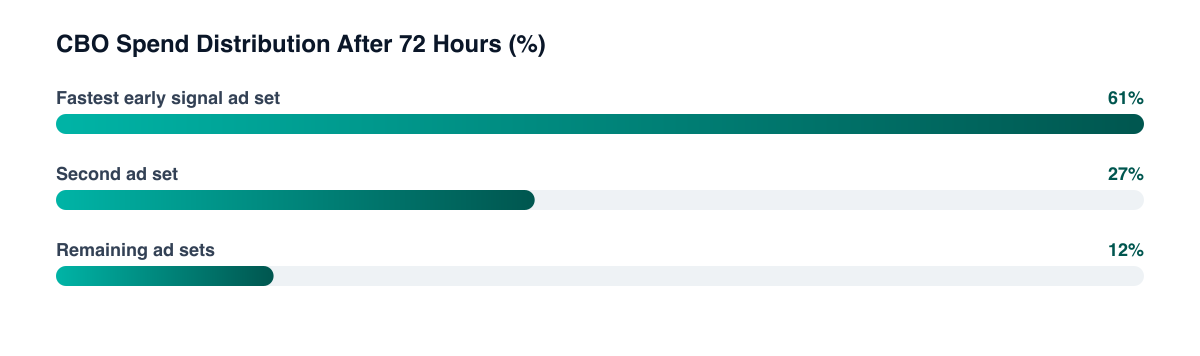
CBO allocates spend based on early signal, and early signal favors ad sets that get cheap, fast results — not necessarily the ones that will scale best over time. A new creative that needs a few days to find its audience can get starved of budget before it has a fair chance, while an ad set with a lower ceiling but faster early wins soaks up the spend. The algorithm isn't wrong about what it's optimizing for; it's just optimizing for early efficiency, which isn't the same thing as long-term performance.
When does CBO actually outperform manual budgets?
- When ad sets are genuinely comparable — similar creative quality, similar audience size, similar offer — so the algorithm is choosing between real options instead of picking the one with a head start.
- At higher daily budgets, where there's enough spend for the algorithm to explore multiple ad sets before committing, rather than converging on the first one that shows a signal.
- For always-on evergreen campaigns without new creative being introduced constantly, where the exploration/exploitation tradeoff has time to settle.
- When testing offers or audiences, not creative formats — CBO tends to make fair calls between structurally similar options and unfair calls between formats with different early-signal speeds.
When does manual budgeting still win?
- Creative testing, where a new concept needs a guaranteed minimum spend to gather signal regardless of how it performs in the first 24 hours — CBO will pull budget away before the test is actually informative.
- Small daily budgets, where CBO doesn't have enough spend to explore before it locks onto whichever ad set converted first, sometimes by chance.
- Campaigns mixing prospecting and retargeting in the same structure — retargeting's naturally lower cost-per-result will out-compete prospecting for budget every time, which quietly shrinks top-of-funnel volume without anyone deciding that on purpose.
The structural fix, not a settings fix If CBO keeps starving new creative, the problem usually isn't a setting to change — it's that creative testing and always-on scaling are running in the same campaign. Split them into separate campaign structures, and let CBO run only where the ad sets are actually meant to compete against each other.
Is there a middle ground between the two?
Yes — minimum spend limits per ad set inside a CBO campaign give new creative a protected floor while still letting the algorithm route the majority of the budget based on performance. This is usually the right answer for teams that want CBO's efficiency without losing the ability to fairly test new concepts, and it avoids the all-or-nothing choice between full algorithmic control and fully manual allocation.
Related guides
- Scale Ad Budgets Without Killing Performance
- Creative Testing Framework: How to Test Without Wasting Spend
- Meta Ads Mistakes That Are Quietly Costing D2C Brands
- Performance Max Campaigns: What Actually Controls Where Your Budget Goes
CBO isn't the wrong choice, and manual budgeting isn't the safe choice — they're two allocation mechanisms that reward different account structures. The account structure decides which one wins, not a general preference for automation or control. Getting that structure right is most of the performance marketing work — the budget mechanism is close to a coin flip once the account underneath it is built correctly.
PART OF OUR SERVICE
Performance Marketing
PROOF FROM A CLIENT
21% sales growth
measured against the pre-engagement baseline · Fashion & Apparel
How Sockscarving Grew Sales 21% and Lifted Conversion Rate 18%→Want a free marketing audit?
We'll review your tracking, ad accounts, and funnel — and show you exactly where the gaps are.
Get Your Free Audit →