How a Food D2C Brand Grew Revenue 4x in 6 Months
KEY RESULT
4x revenue growth
from $18K to $72K monthly revenue
Monthly Revenue
$72K
from $18K
Customer Acquisition Cost
$18
from $42
Return on Ad Spend
4.2x
from 1.8x
Payback Period
38 days
from 94 days
The Challenge
When this food brand came to us, they had everything right on the product side — strong reviews, healthy repeat purchase rate, and a clear core customer. The problem was acquisition. They were spending $22K/month on Meta with a 1.8x ROAS and no real understanding of what was working.
Their ad account had grown organically over 18 months — campaigns layered on top of campaigns, audience overlaps everywhere, and no consistent creative testing methodology. Every time a creative stopped performing, they'd launch a new one from scratch rather than understanding why it worked in the first place.
The result was a CAC of $42 on a $68 average order value, with a 94-day payback period. At their growth ambitions, the unit economics simply didn't work.
What We Did
1. Full Attribution Audit
We started with a three-week attribution audit before touching a single campaign. We mapped every touchpoint — Meta click, Meta view-through, Google brand search, organic — against actual revenue in Shopify.
What we found: roughly 30% of attributed revenue in Meta was double-counting conversions from Google brand searches. Their actual Meta ROAS was closer to 1.2x. This was the most important finding — because it told us the creative strategy was actually working, but the efficiency was buried under misattribution.
2. Campaign Consolidation and Funnel Restructure
We collapsed 34 active ad sets into a three-campaign structure: TOF (Advantage+ Shopping), MOF (retargeting warm audiences), and BOF (cart and checkout abandonment). We eliminated audience overlaps entirely and let Meta's algorithm optimize across consolidated spend rather than fighting itself.
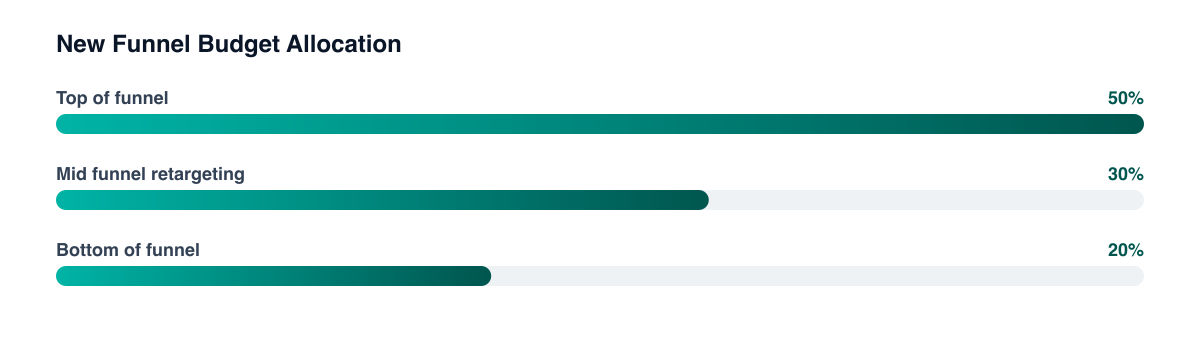
Budget allocation shifted from 60/20/20 (TOF/MOF/BOF) to 50/30/20 — heavier retargeting spend targeting the 60-day window where their product consideration was highest.
3. Creative Testing Framework
Instead of launching new creatives reactively, we built a systematic testing pipeline: five hooks per week, tested in small-budget POC campaigns before scaling winners. We identified that UGC-style unboxing content with explicit social proof (reviews read aloud) was outperforming studio content by 2.3x on hook rate.
We also tested offer framing — same product, different value propositions — and found "family pack" positioning drove 40% higher AOV than single-unit messaging.
4. Google Capture Layer
Because their product had strong branded search intent (their social content was driving discovery), we added a Google Search campaign to capture that intent before competitors could. Branded search CPC at $0.18 made this extremely efficient. This campaign alone recovered the "lost" conversions we had identified in the attribution audit.
The Results
By month three, CAC had dropped to $24. By month six, we had it at $18 — a 57% reduction — while simultaneously growing monthly revenue from $18K to $72K. ROAS stabilized at 4.2x once the attribution model was clean.
The payback period compression from 94 to 38 days was the most strategically significant change: it meant the brand could reinvest in growth much faster, creating a compounding effect. By month six they had enough margin to increase total ad spend by 60% without touching their unit economics targets.
“The team completely transformed how we think about our ad spend. We went from guessing to knowing — and the revenue followed.”
— Founder, Food D2C Brand
+ DEEPER READING
The tactics behind these results
Meta Ads for D2C Brands: The Complete 2026 Playbook
Everything you need to run profitable Meta ads for your D2C brand in 2026 — campaign structure, creative strategy, tracking setup, audience architecture, and the exact frameworks we use to scale accounts from $10k to $500k/month.
Read guide →
PAID SEARCHGoogle Ads for D2C Brands: The Complete 2026 Playbook
The complete guide to running Google Ads for D2C brands in 2026 — Shopping campaign structure, Performance Max vs Standard Shopping, search ads strategy, feed optimization, and how to scale budgets without tanking efficiency.
Read guide →
PERFORMANCE MARKETINGWhy Your ROAS Is Lying to You (And How to Fix It)
Most D2C brands trust their reported ROAS blindly — but platform-reported ROAS is almost always inflated. Here's why, and how to calculate your true blended ROAS.
Read guide →
PERFORMANCE MARKETINGHow to Scale Ad Budgets Without Killing Performance
Doubling your ad budget doesn't double your results — it often tanks them. Here's the framework for scaling spend gradually while protecting ROAS and efficiency metrics.
Read guide →