

Every November, merchants in the US, UK and Australia quietly extend their return window to "until January 31" and call it a gift-season feature. Few of them model what that promise costs when the parcels come back in the second week of January.
"A generous return window is a marketing decision you pay for in operations. Price it before you print it on the banner."
— Nitesh Kasma, Co-Founder — Brand Strategy & Client Growth
Why do extended holiday windows lift conversion?
Gift buyers are buying for someone else's size, taste and wardrobe, and a November purchase for a December 25 gift can't be returned inside a standard 30-day window. An extended window removes that objection at the point of purchase. The effect is strongest in categories where fit or preference is uncertain (apparel, footwear, accessories, home) and weakest for consumables, where there is little to return.
We can't give you a reliable uplift number: it varies by category, price point and how visible the policy is. Treat it as a hypothesis you test, for example by showing the extended policy on product pages for half your traffic, rather than a given. Our returns experience guide covers the broader retention case; this post is about the seasonal decision.
What does an extended window do to January?
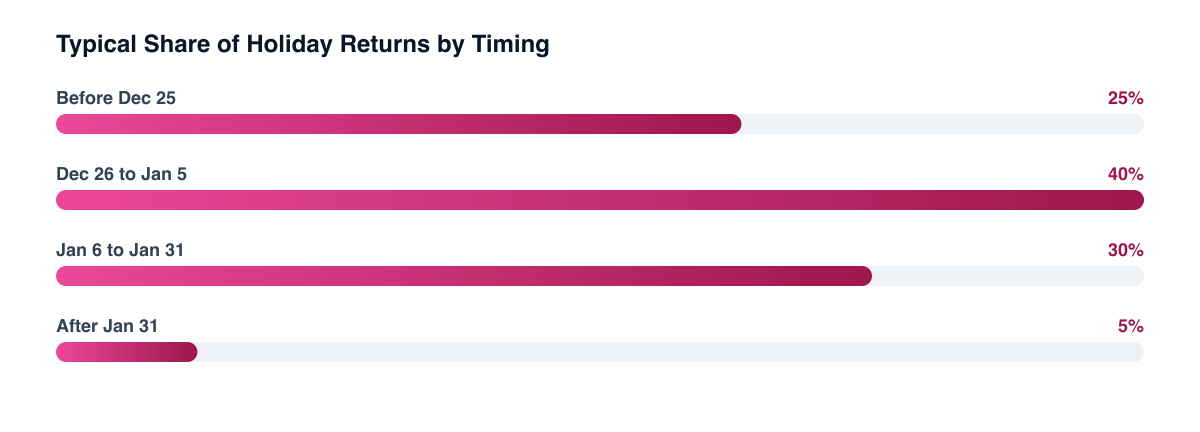
It moves a large block of returns into a month when your team is back, your ad spend is lower and your cash is tied up in refunds. Two mechanisms matter.
- Delay, not just volume. Some buyers would have returned in December anyway; the longer window pushes those returns later, so the refund lands after your peak revenue has already been reported.
- Gift returns skew to refunds. A recipient with no relationship to your brand has less reason to take an exchange, so gift returns tend to cost more per order than your normal mix. That is practitioner experience, not a published figure; check it against your own return reasons.
Your own last-year data is the right guide. Pull holiday-season orders and chart returns by week against the window you offered.
How do you control the cost without killing the benefit?
You rarely need to choose between "generous" and "strict". These levers keep the headline promise intact:
- Exchange and store credit first. Offer the exchange or credit as the easy default, with refund to original payment still available. Customers who want their money back should be able to get it; making that hard invites chargebacks and bad reviews.
- Charge for return shipping, selectively. A paid label on refunds but a free label on exchanges nudges behaviour without a blanket fee. Be aware that in the UK, for online orders, the rules interact with who pays return postage (see below).
- Cap the extension by product. Exclude final-sale, personalised, hygiene-sensitive and low-margin items, and say so on the product page, not only in the policy.
- Keep the window tied to the order date. "Orders placed November 1 to December 24 can be returned until January 31" is clear and finite.
Keep the unit economics honest too: a free return on a discounted item can erase the margin you built the Black Friday offer around.
Model the return window like a discount Estimate return rate times refund cost times the extra days of exposure, then subtract it from the seasonal margin before approving the extension. If the number surprises you, narrow the window or the eligible products.
What do UK, Australian and US rules actually require?
This is operational context, not legal advice. Check the regulator's page for your situation.
- UK: For online and distance sales, GOV.UK's guidance for businesses says customers can cancel within 14 days of receiving the item, have a further 14 days to send it back, and must be refunded within 14 days of you receiving it. It also says you must refund standard delivery if the customer paid for it. Anything beyond that, such as a holiday extension, is your own policy, and you should honour what you publish. The CMA and Trading Standards also care about misleading return terms, so keep the policy consistent across pages.
- Australia: The ACCC says a consumer is generally not entitled to a remedy under the consumer guarantees just because they changed their mind, so change-of-mind returns are a business choice, but a business that offers them must follow its own policy. Faulty goods are different: a policy cannot take away statutory rights. See the ACCC's guidance (the ACCC page blocked our automated check, so read it directly).
- US: We could not confirm a single federal rule requiring change-of-mind returns; our understanding is that policies are largely set by the seller, with some state-level disclosure requirements that vary. The FTC does enforce shipping and refund obligations when an order isn't delivered on time, under its Mail, Internet, or Telephone Order Merchandise Rule. Check your state and the FTC before assuming anything stricter or looser.
How do you use returns to protect retention?
A return is the moment a customer decides whether to come back. Send a clear status email at each step, make the exchange path the first button, and flag the customers who return but still engage so they enter a win-back flow rather than a generic one. Retention math over the following year, covered in customer lifetime value, often shows that a smooth return keeps a customer who a painful one loses.
Related guides
- Returns Experience as a Retention Lever for D2C
- Customer Lifetime Value: The Complete Guide
- Win-Back Campaigns for D2C
- BFCM Media Planning Timeline
Set the window before the sale, publish it everywhere the customer decides, and have a January plan for the parcels that come back. If you want help turning returns and exchanges into a retention flow, our CRM and retention team can build it with you.
Want a free marketing audit?
We'll review your tracking, ad accounts, and funnel — and show you exactly where the gaps are.
Get Your Free Audit →