
Every few years someone declares Quality Score dead. It isn't — but what it's useful for has narrowed considerably, and treating it as a score to raise is the wrong frame.
"Quality Score isn't a grade to improve. It's a diagnostic that tells you which of three specific things is out of alignment."
— Dhruvit Shah, Co-Founder — Performance Marketing & Growth Strategy
What does it actually affect?
Ad Rank, which determines both whether your ad shows and what you pay when it's clicked. Google's own documentation is consistent on this: a higher-quality ad can occupy a better position at a lower cost per click than a competitor bidding more. That relationship hasn't changed with the shift to automated bidding — what changed is that you no longer set the bid manually, so the effect shows up as a lower average CPC rather than a bid you adjusted yourself.
What Quality Score does not do is act as a lever you pull directly. It's reported at the keyword level, on a 1–10 scale, as an aggregate of three components — and the aggregate is the least useful number in the report.
How do you actually read the components?
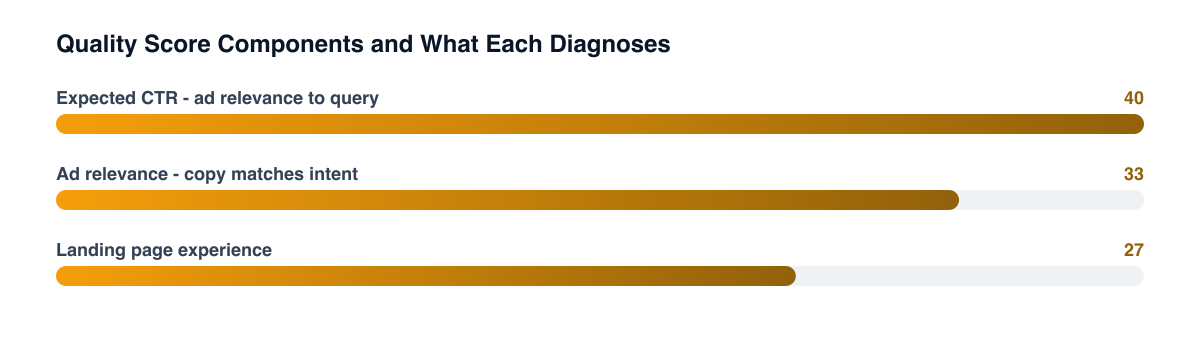
Ignore the 1–10 number and look at the three sub-ratings, each reported as Below Average, Average, or Above Average:
- Expected click-through rate below average means the ad isn't compelling for that query relative to competitors. This is usually a copy problem, occasionally a position problem, and it's the component most responsive to testing new headlines.
- Ad relevance below average means the ad copy doesn't reflect the query's intent — most often a symptom of an ad group covering too many different intents at once. The fix is structural, not creative: split the ad group.
- Landing page experience below average means the destination doesn't deliver what the ad promised, loads slowly, or is hard to use on mobile. This is the component most brands ignore and the one most likely to be genuinely broken.
Each component points at a different team and a different fix, which is exactly why the aggregate score is unhelpful — a 5/10 tells you nothing about which of the three is dragging.
Low volume keywords have unreliable scores Quality Score on a keyword with almost no impressions is largely a category-level prior rather than a measurement of your ad. Don't restructure an account around scores on keywords that have barely served.
Does any of this matter under Performance Max and broad match?
Less directly, and it varies by campaign type. Performance Max doesn't expose keyword-level Quality Score at all, so the diagnostic disappears — but the underlying relevance and landing page quality signals still influence what you pay. In search campaigns using broad match with automated bidding, Quality Score remains visible and remains a useful early warning: a fleet of keywords sliding to below-average ad relevance usually means the ad groups have drifted wider than the copy, which the search term report will confirm.
What's the practical routine?
Check the three components quarterly, filtered to keywords with real impression volume, and act only on the ones flagged Below Average. Restructure ad groups where ad relevance is weak, test headlines where expected CTR is weak, and fix the destination where landing page experience is weak — the last of which is usually a CRO and page speed job rather than an ads job. That's the whole workflow; anything more elaborate is optimising a reported number rather than the account.
Related guides
- Google Ads for D2C Brands: The Complete Guide
- Search Term Report Audits: Finding the Wasted Spend
- Performance Max Campaigns: What Actually Controls Your Budget
- Google Shopping Campaign Structure That Works
Quality Score's reputation problem comes from being treated as a scoreboard. Read as three separate diagnostics, it's still one of the few free signals paid search gives you about why an account is paying more than it should.
PART OF OUR SERVICE
Performance Marketing
PROOF FROM A CLIENT
15x revenue growth
monthly revenue, March to August 2026 · Fashion & Apparel
How AM by Anita Mittal Went from Planning to Close the Store to 15x Revenue→Want a free marketing audit?
We'll review your tracking, ad accounts, and funnel — and show you exactly where the gaps are.
Get Your Free Audit →