
Most D2C brands losing money on paid ads don't have a traffic problem — they have a conversion problem. The conversion figures throughout come from Shopify stores we've audited directly; where a number comes from published research instead, it's linked.
"Most D2C brands losing money on paid ads don't have a traffic problem — they have a conversion problem."
— Dhruvit Shah, Co-Founder — Performance Marketing & Growth Strategy
Before you spend another dollar on Meta or Google, fix the store.
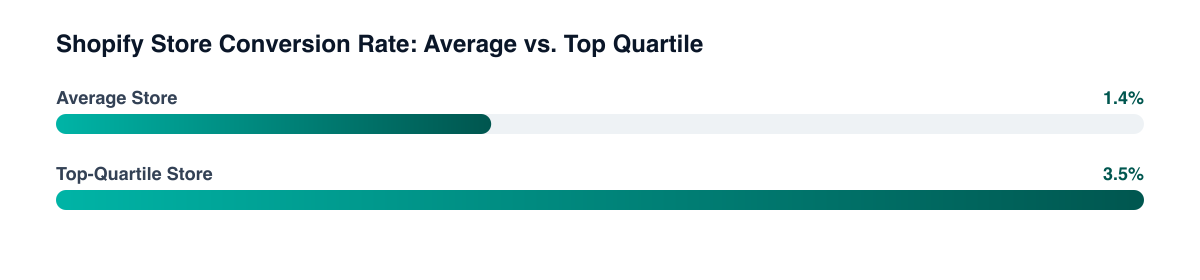
The average Shopify store converts at 1.4%. Top-quartile stores convert at 3.5% or higher. That gap is not about better products or lower prices — it's about optimizing every step between the first click and the purchase confirmation. Double your conversion rate and you've effectively halved your customer acquisition cost without touching your ad spend. That's the multiplier effect, and it's why CRO deserves to come before scaling.
Why Should CRO Come Before Ad Spend?
Paid acquisition is an amplifier. It takes whatever your store already does — convert visitors into customers or fail to — and multiplies it by spend. If your store converts at 1%, spending $10,000 on ads gets you 100 customers. If your store converts at 3%, the same $10,000 gets you 300 customers. The math is elementary, but most founders skip to the ad budget before auditing the funnel.
The compounding effect goes deeper than raw conversions. A better-converting store generates more revenue per visitor — we measured a 68% lift in exactly that metric for a health and wellness brand without adding a rupee of ad spend — which means you can afford to pay more per click than your competitors and still turn a profit. On platforms like Google Shopping and Meta, where auction dynamics mean the highest bidder with an acceptable return wins the impression, CRO becomes a structural competitive advantage — not just a nice-to-have.
There's also the feedback loop problem. Running high-volume traffic to an unoptimized store burns through your retargeting audiences and exhausts warm prospects before they're ready to buy. You're not just losing the first sale — you're poisoning the well for every subsequent touchpoint.
The standard CRO playbook recommends reaching statistical significance on tests before scaling. In practice, this means you need baseline traffic before you can test anything meaningful. But the sequence matters: audit and fix the obvious leaks first, then test, then scale. Don't wait for test results to fix a broken mobile checkout.
The fix Before increasing your ad budget by even 10%, run a 30-minute audit: pull your store's conversion rate by device (mobile vs. desktop), by traffic source, and by landing page. If mobile converts at less than half your desktop rate, you have a UX problem that ad spend will only make more expensive.
The Product Page: Why Is It the Most Important Sales Asset You're Probably Underinvesting In?
The product page is where purchase decisions are made or lost. It is not a catalog entry — it's a sales conversation at scale. Yet most Shopify stores treat it like a form to fill out: a few product photos, a title, a description copied from a supplier, and a button.
A high-converting product page anatomy has nothing to do with aesthetics. It has everything to do with answering the right questions in the right order, at the moment a skeptical stranger is trying to decide whether to trust you with their money.
The hierarchy of a product page that converts looks like this. Above the fold: your hero image or video communicates the product in context (not on a white background), your headline names the specific benefit not just the product, your price is visible without scrolling, and your primary CTA is unmissable on both mobile and desktop. Social proof — review count and aggregate star rating — appears before the fold on desktop, immediately after the CTA on mobile.
Below the fold is where most stores lose the sale. This is where objections live. The visitor who scrolled down is interested but unconvinced. Ingredients, materials, dimensions, how-it-works explanations, comparison tables against alternatives, FAQ sections addressing specific hesitations, and deeper review content — this is the work that turns browsers into buyers.
| Element | Low-converting store | High-converting store |
|---|---|---|
| Hero image | Product on white background | Product in use, showing transformation |
| Headline | Product name only | Benefit-forward headline |
| Social proof | Below the fold, minimal | Above fold, specific (e.g., "4.8 stars, 2,400 reviews") |
| CTA copy | "Add to Cart" | Action-oriented ("Start your routine") |
| Objection handling | None or buried | FAQ, guarantee, size guide prominent |
| Mobile experience | Desktop layout scaled down | Native mobile layout, thumb-friendly |
Video is the single highest-leverage change most brands can make to a product page. A 15–30 second video demonstrating the product in use typically lifts conversion by 10–30% for products where the mechanism of action matters — skincare, fitness equipment, kitchen tools, anything where "how it works" is a key purchase driver.
One element most stores underweight is specificity in social proof. "Great product!" does nothing. A review that says "I've been using this for 6 weeks and my rosacea is genuinely calmer — I've tried four other serums and this is the only one that didn't irritate me" is doing heavy sales lifting. Surface your most specific, detailed reviews prominently, and if you're running review request emails, prompt customers with specific questions rather than a blank text box.
Cart Abandonment: Why Are 70% of Carts Abandoned, and How Do You Recover Them?
Seventy percent of shopping carts are abandoned before purchase. This is not a failure — it's an opportunity. The visitor who added to cart and left is the hottest lead in your funnel. They've told you exactly what they want. The question is why they didn't buy.
Reducing cart abandonment starts with understanding the actual reasons, not the assumed ones. Most brands assume price is the primary driver. Research consistently shows that unexpected costs at checkout — primarily shipping, taxes, and fees revealed late in the process — are the leading cause of abandonment. The second most common reason is being required to create an account. Third is a checkout process perceived as too long or complicated.
These are structural problems, not persuasion problems. Fix the structure before building recovery flows.
On the structural side: display shipping costs (or "free shipping over $X") on the product page, not at checkout. Enable guest checkout — Shopify has made this easier, but many stores still default to account creation. Reduce checkout steps. Enable Shop Pay, Apple Pay, and Google Pay. These are not tests; they are table-stakes fixes that will immediately reduce abandonment.
On field count specifically, Baymard's benchmarking of checkout form fields found the average checkout asks for substantially more fields than it needs — most flows can be cut to roughly half without losing anything the merchant actually uses. Go through your own checkout field by field and justify each one against a real operational need; "nice for our CRM" is not one.
The fix Audit your checkout funnel in Shopify Analytics. Look at the drop-off rate at each step: cart → information → shipping → payment. Where does the biggest drop happen? If it's information → shipping, unexpected shipping cost is your culprit. If it's cart → information, your checkout initiation experience needs work — potentially the CTA, trust signals, or mobile experience on the cart page.
Recovery flows are where you recapture the damage. A three-part abandoned cart email sequence — sent at 1 hour, 24 hours, and 72 hours — is standard. The first email should be a simple, direct reminder with no discount. Introducing a discount in the first email trains customers to abandon carts on purpose. The second email adds social proof or addresses a likely objection. The third email is where you can introduce an incentive if the first two didn't convert.
SMS abandoned cart recovery converts at a higher rate than email for most Shopify brands, but the bar for relevance and timing is higher. A text message that arrives 10 minutes after abandonment feels helpful. One that arrives four days later feels like spam. Stack SMS with email rather than substituting one for the other.
What Are the 10 CRO Tests Every Shopify Store Should Run Before Scaling?
Testing without a hypothesis is decoration. Every CRO test should start with a specific belief: "We believe that [change] will [outcome] because [reason]." This forces prioritization and makes results meaningful.
The 10 Shopify CRO tests worth running before scaling aren't the flashiest experiments — they're the ones with the highest probability of meaningful impact. They cover product page hero images, headline framing, CTA copy and placement, checkout trust signals, shipping threshold messaging, review placement, bundle and upsell positioning, mobile navigation, and page load speed.
On that last one, work against defined thresholds rather than a vague sense that the site feels slow. Google's Core Web Vitals define the measurable targets, and Largest Contentful Paint — which should occur within 2.5 seconds of page load starting — is the one that most directly tracks how quickly a shopper sees your product. Measure it on a real mobile connection, not a desktop test.
The fix Don't test color changes. Test value proposition framing. Don't test button shapes. Test whether adding a money-back guarantee above the fold lifts conversion. High-impact tests change what the customer understands about the offer — not what the page looks like.
Statistical significance is non-negotiable. A test that ran for five days and "looks like it's winning" is not a result — it's noise. Use a sample size calculator before you start any test, set your minimum detectable effect based on a meaningful business impact, and do not call tests early. For most mid-size Shopify stores (under 50,000 monthly sessions), this means running tests for three to four weeks minimum.
Test one thing at a time. Multivariate testing sounds efficient but requires dramatically more traffic to reach significance and makes it nearly impossible to understand what actually drove the result.
Customer Lifetime Value: How Does It Determine What You Can Afford to Spend?
CAC tells you what you paid for a customer. LTV tells you whether that was a good investment. Most Shopify brands optimize for first-order profitability and leave significant acquisition potential on the table because they don't know their true LTV by cohort.
The complete Customer Lifetime Value guide goes deep on calculation methodologies, but the strategic implication is simple: brands with higher LTV can afford to pay more for acquisition and still win. If your 12-month LTV is $180 and a competitor's is $90, you can bid twice as aggressively for the same customer and still come out ahead. LTV is a competitive moat.
| LTV cohort | What it means for acquisition |
|---|---|
| Low LTV (< 2x AOV) | Must achieve profitability on first order; limits ad scale |
| Mid LTV (2–4x AOV) | Can acquire at breakeven on first order; room to compete |
| High LTV (4x+ AOV) | Can acquire at a first-order loss; outbids competition at scale |
The most actionable LTV lever for Shopify brands is the post-purchase experience. The email and SMS sequence that begins the moment someone buys — order confirmation, shipping update, unboxing tips, product usage guide, replenishment reminder — is the highest-ROI marketing touchpoint you have. The customer is maximally engaged, their credit card just worked, and they have zero buyer's remorse yet. Use that window.
Subscription programs, loyalty programs, and product bundling all improve LTV structurally, but only if the core product experience justifies a second purchase. Before building retention mechanics, make sure the product delivers on the promise. No retention program outperforms a product people genuinely want to reorder.
The CRO Stack: Which Tools, What Testing Velocity, and When Do You Stop?
The tool question is almost always the wrong question. Brands spend weeks evaluating A/B testing platforms when the limiting factor is test velocity and hypothesis quality, not software features.
For most Shopify stores under $5M in annual revenue, the right CRO stack is: one A/B testing tool (Convert, VWO, or Optimizely — pick one and use it), one session recording and heatmap tool (Hotjar or Microsoft Clarity, which is free), Shopify's native analytics for funnel data, and a structured testing log in a shared spreadsheet. That's it.
The fix Before adding any new CRO tool to your stack, define the specific question you need it to answer. "I want to see where users click on the product page" is a question Clarity can answer for free. "I want to know why users who add to cart don't complete checkout" is a question a short post-abandonment survey ($0 with Typeform) can answer before you spend money on session replays.
Testing velocity matters more than platform sophistication. A brand running two tests per month with clean hypotheses and proper significance thresholds will outperform a brand running one test per quarter on enterprise software. The compounding benefit of iterative improvement is significant: 12 valid tests per year at a 30% win rate means nearly four confirmed conversion improvements. At a 2% baseline, four sequential 15% relative improvements get you to 3.4%.
When should you stop testing? Never completely — but know when to shift focus. If you've run 20 tests on your product page and the last six have been flat or negative, the product page is optimized for your current traffic mix. The constraint has moved. Audit your traffic quality, your offer, or your post-purchase funnel instead.
The highest-leverage inflection point for testing investment is when you're preparing to scale paid acquisition significantly. The difference between a 1.5% and 2.5% conversion rate at $50,000/month ad spend is approximately $1,500 in additional monthly profit — and that math gets exponentially more valuable at $200,000/month.
The Bottom Line
CRO is not a campaign — it's a compounding system. Every percentage point improvement in conversion rate reduces your effective CAC, improves your LTV payback period, and gives you more room to compete on paid acquisition. The brands that scale profitably on paid media are almost always the ones that fixed the funnel first. Start with your product page, eliminate the structural causes of cart abandonment, run disciplined tests with real hypotheses, and let LTV data set your acquisition ceiling. The stores that win aren't spending more — they're converting better.
Everything in this cluster
10 Shopify CRO Tests to Run Before Scaling Your Ad Spend
High-Converting Product Page Anatomy: What the Best Shopify Stores Get Right
Reducing Cart Abandonment: How to Recover 15–25% of Lost Carts Without Defaulting to Discounts
Work with us on this
If you want your Shopify store designed, optimized, and continuously improved for conversion, our Shopify & CRO service covers everything from product page redesigns to checkout optimization to speed improvements — with ongoing A/B testing built in.
Customer Lifetime Value Guide: How to Calculate, Segment, and Use LTV to Drive Profitable Growth
PART OF OUR SERVICE
Shopify & CRO
PROOF FROM A CLIENT
+68% revenue per visitor
without increasing ad spend · Health & Wellness
How a Health Brand Lifted Revenue Per Visitor by 68%→Want a free marketing audit?
We'll review your tracking, ad accounts, and funnel — and show you exactly where the gaps are.
Get Your Free Audit →