
Most advice on getting cited by AI answer engines is classic SEO with a new label, sold with more confidence than the evidence supports. Some of it holds up, some of it is a guess, and a brand in the US, UK or Australia needs to know which is which before reorganising its content.
"Nobody outside the labs knows the citation algorithm. What you can do is make your pages easy to retrieve, easy to quote and hard to misread."
— Aashish Kasma, Co-Founder — Data & Analytics
Do you need special optimisation to appear in AI Overviews and AI Mode?
Google says no. Its AI features documentation states that a page must be indexed and eligible to show in Search with a snippet, that there are no additional technical requirements, and that you do not need special schema.org markup. Its separate guide to generative AI search says structured data isn't required for generative AI search and that you don't need new machine-readable or AI text files.
The same documentation says both features may use "query fan-out", issuing several related searches across subtopics. That has a practical consequence: your page can be pulled in for a sub-question the user never typed. Pages that answer one narrow question well have more entry points than one page that gestures at ten.
What did the GEO study actually find?
The most cited research is the Princeton and Georgia Tech paper on Generative Engine Optimization, accepted to KDD 2024. The authors built a benchmark and tested rewriting strategies. Per the full paper, the top methods (Cite Sources, Quotation Addition and Statistics Addition) gave a relative improvement of 30-40% on its Position-Adjusted Word Count metric, while keyword stuffing offered little to no improvement. It also reports that lower-ranked sites benefited more.
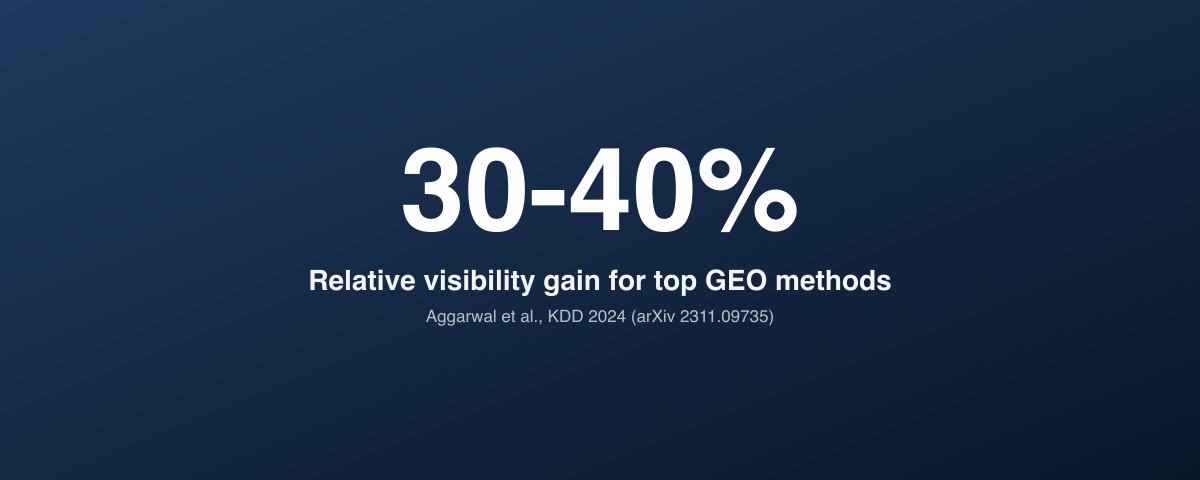
Read the caveats before quoting it. The main evaluation generated answers with gpt-3.5-turbo, with a further test on Perplexity. It measures a share of words attributed to a source in a benchmark, not citations in live ChatGPT or Google results and the paper was first posted in 2023. It is evidence about which kinds of content get used by a language model, not a guarantee about any product today.
What does retrieval plausibly reward?
Treat these as working hypotheses rather than proven ranking factors: being indexed and crawlable by the right bot, answer-first passages, quotable specifics with named sources, entity clarity across your site and profiles, and third-party mentions. The first is best supported and the last is unconfirmed.
Treat the following as working hypotheses, ordered by how well supported they are:
- Being indexed and crawlable by the right bot. ChatGPT search relies on OAI-SearchBot, and OpenAI's crawler documentation says sites opted out of it will not be shown in ChatGPT search answers. Our crawler and robots.txt guide covers the details.
- Answer-first passages. A direct answer in the first sentence under a question-shaped heading is easy to lift. This is a design choice consistent with how snippets have always worked, not a tested ranking factor.
- Quotable specifics. The GEO study's best performers added sources, quotations and statistics. Real figures with a named source are the version of that you can defend. Invented ones are worse than none.
- Entity clarity. One consistent name, description and set of facts across your site, profiles and listings, so a model does not have to guess what you are. Our product page structured data guide shows the on-page side.
- Third-party mentions. Reviews, press and directory listings plausibly matter because engines draw on the wider web. We have not found a controlled study we are willing to cite for how much, so we treat it as unconfirmed.
How is this different from classic SEO?
Less than the vendors suggest. Google's own position is that optimising for generative search is optimising for the search experience, so the foundation is unchanged: crawlable pages, original content, clear structure. The differences are in measurement and in surfaces. Citations are often invisible in analytics (see measuring AI search traffic in GA4), and non-Google engines have their own retrieval and their own rules.
For B2B the main change is that buyers ask comparative, problem-shaped questions ("what should we look for in a data pipeline vendor") and an answer engine assembles a shortlist. Pages that state who a product is for, and who it is not for, plainly are easier to place in that shortlist than pages of positioning copy. For D2C, product facts matter more, which is the subject of the product page guide above.
Start with the pages that already rank Sample 20 buyer questions in ChatGPT, Perplexity and Google AI Mode, record who is cited, and rewrite your existing top-ranking pages answer-first before writing anything new. Repeat the sample monthly to see movement.
What should you skip?
Keyword stuffing, which the study found useless. Blanket FAQ schema added "for AI", which Google says it does not require. Any agency promising a guaranteed citation count. And large-scale AI-generated filler, which adds pages without adding anything a model could not already say.
Related guides
- How to Measure AI Search Traffic in GA4
- What an AI-Citable Shopify Product Page Looks Like
- D2C Analytics and Attribution: The Complete Guide
- First-Party Data Strategy for D2C Brands
AI citation is a retrieval problem you influence, not control, so the sensible plan is cheap, reversible content improvements plus honest measurement. If you want help building that baseline and a prioritised page list, see our AEO and AI search service.
PART OF OUR SERVICE
AEO & AI Search
Want a free marketing audit?
We'll review your tracking, ad accounts, and funnel — and show you exactly where the gaps are.
Get Your Free Audit →