
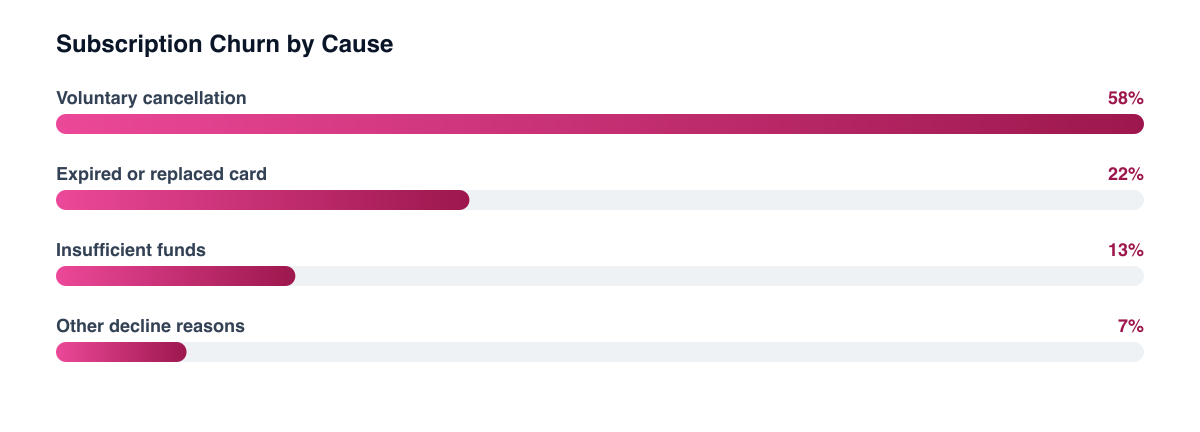
When a subscriber disappears, the retention report calls it churn. Often it's a card that expired, a bank that declined a routine charge, or a billing address that went stale after a move.
"Involuntary churn is the only kind of churn where the customer still wants your product. Winning it back is a billing problem, not a persuasion problem."
— Nitesh Kasma, Co-Founder — Brand Strategy & Client Growth
Why does this get missed?
Because most dashboards report a single churn number. Voluntary cancellations — someone clicking cancel — and involuntary lapses from failed payments land in the same bucket, and the team responds to both with the same tactics: better onboarding, a win-back discount, a survey asking why they left. None of which address a declined card.
The fix starts with separating the two in reporting. Once involuntary churn is its own line, its size is usually surprising, and the work to reduce it is far more mechanical than the work to reduce genuine cancellations.
What does a working recovery sequence look like?
- Retry on a schedule, not immediately. An instant retry hits the same condition that caused the decline. Spacing attempts over several days — and timing at least one to land after a typical payday — recovers a meaningful share with no customer contact at all.
- Email on the first failure, not the last. A short, non-promotional message that names the specific problem ("your card ending 4412 was declined") gets acted on. A vague "there was an issue with your account" reads like phishing and gets ignored.
- Send the update-card link directly, to a page that requires no login. Every authentication step between the email and the form loses recoveries.
- Use a second channel before giving up. SMS or WhatsApp on the final attempt reaches people who've stopped opening marketing email — this is a transactional message, and it performs like one.
- Pause rather than cancel when retries are exhausted, so the subscription can be resumed in one click instead of rebuilt from scratch.
Prevention beats recovery Card-expiry updater services offered by most payment processors refresh card details automatically when a bank reissues them. Enabling one is usually a settings change, and it removes the largest single cause of involuntary churn before any email needs sending.
Where do brands get the tone wrong?
By making it feel like a marketing message. Failed-payment emails frequently arrive with the brand's full promotional template — hero image, product grid, discount banner — and get filtered or skipped along with everything else. A plain-text-style message from a real sender, with one link and no upsell, performs far better because it reads as what it is: a service notification.
The other common mistake is discounting. Offering money off to recover a failed payment trains the wrong behaviour and, worse, converts a purely administrative problem into a margin one. The customer didn't ask for a discount — they asked for nothing, because they don't yet know the payment failed.
What should you measure?
Recovery rate on failed payments, split by attempt number, and involuntary churn as a percentage of total churn. If involuntary churn is a large share, the highest-return retention work isn't a new win-back campaign or a loyalty tier — it's the billing sequence. Once that's tightened, the remaining churn number is finally an honest signal about the product and the offer, which makes every other retention decision better informed.
Related guides
- D2C Retention Strategy: Building Revenue That Compounds
- The D2C Subscription Model: Making Recurring Revenue Work
- Win-Back Campaigns for D2C
- SMS and WhatsApp Marketing for D2C Brands
There aren't many places left in D2C where a few days of setup recovers real recurring revenue. A properly built dunning sequence is one of them — and it's usually sitting untouched inside the retention stack you already pay for.
PART OF OUR SERVICE
CRM & Retention
PROOF FROM A CLIENT
+45% repeat purchase rate
from 22% to 32% of customers purchasing again within 90 days · Beauty & Personal Care
How a Beauty D2C Brand Lifted Repeat Purchase Rate by 45% with a Loyalty Program Rebuild→Want a free marketing audit?
We'll review your tracking, ad accounts, and funnel — and show you exactly where the gaps are.
Get Your Free Audit →