
A webinar with 400 registrants and 30 live attendees isn't a failed webinar — it's two different assets that most teams only measure as one. The registration list is a lead-gen result; the live session is a sales-enablement result, and grading both against "attendance" undersells the format.
"A webinar with 400 registrants and 30 live attendees isn't a failed webinar — it's two different assets that most teams only measure as one."
— Nitesh Kasma, Co-Founder — Brand Strategy & Client Growth
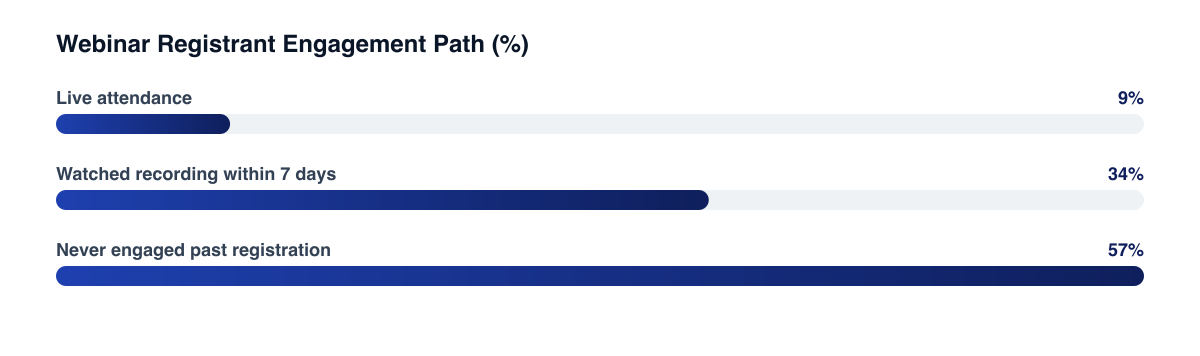
Why has live attendance dropped so much?
Buyers now register for the content, not the live event — the on-demand recording is often the actual product they wanted, and the calendar invite was just a way to make sure they didn't forget it existed. That's not a sign the format is failing; it's a sign the value moved from "showing up live" to "the resource existing at all." Programs still grading themselves purely on live attendance rate are measuring the wrong half of the funnel.
What actually predicts whether a webinar generates pipeline?
- Registrant fit, not registrant count. A webinar that pulls 150 registrants matching your ICP outperforms one that pulls 600 registrants scraped from a broad ungated promotion.
- A specific, narrow topic, not a broad category overview — "how we cut onboarding time for mid-market ops teams" outperforms "the future of ops software" because it self-selects for buyers already evaluating the problem.
- A follow-up sequence that treats the recording as an asset, not a courtesy email — the on-demand view is where most of the actual engagement happens, and it deserves its own nurture path, not a single "sorry we missed you" send.
- Sales involvement in the follow-up for high-fit accounts, not a purely marketing-owned nurture — a registrant from a target account who watched the full recording is a warmer signal than most inbound form fills.
The metric that actually matters Track pipeline sourced or influenced by webinar registration and viewing, not just registration count or live attendance rate. If that number is near zero after a few cycles, the format isn't the problem — the topic selection or follow-up probably is.
Is a live Q&A still worth the effort if attendance is low?
Yes, for a different reason than volume: a live session with 20 highly-fit attendees who ask real questions produces better content for every future touch than a recording alone would — objections surfaced live become talk-track material for sales enablement, and a small, engaged room often converts better per-attendee than a passively-watched recording. Low attendance isn't automatically a failure signal if the attendees who did show up were the right ones.
When should a webinar not be the format at all?
If the goal is broad awareness rather than mid-funnel education, a webinar's production effort rarely pays off compared to content marketing or paid distribution aimed at the same audience. Webinars work best for a buyer already aware of the problem and evaluating solutions — using the format to introduce a category to someone who's never thought about the problem before is usually a mismatch that shows up as high registration and low pipeline.
Related guides
- B2B Content Marketing for Lead Generation: What Actually Compounds
- B2B ICP Definition and Targeting: Who Actually Belongs in the Funnel
- Account-Based Marketing: The Playbook for Mid-Market B2B Brands
- B2B Lead Nurturing Strategy: Turning Registrants Into Pipeline
Webinars aren't dead, but the version of the format that worked five years ago — optimize for live attendance, treat the recording as leftover — is. The programs still generating pipeline from webinars are the ones that stopped measuring the live room and started measuring the whole registrant list. The ones still worth running are built as B2B lead generation assets with a life well past the live date, not as events that end when the recording stops.
PART OF OUR SERVICE
B2B Lead Generation
PROOF FROM A CLIENT
$340K pipeline
quarterly qualified pipeline from near zero · SaaS / Technology
How a B2B SaaS Company Built a $340K Quarterly Pipeline→Want a free marketing audit?
We'll review your tracking, ad accounts, and funnel — and show you exactly where the gaps are.
Get Your Free Audit →