
Every brand that gets Sponsored Products working eventually hits the same wall: the profitable search terms are saturated, spend can't grow without ACoS deteriorating, and someone suggests DSP. Sometimes that's right. Often it's three quarters early.
"Sponsored Products doesn't create demand, it collects it. When collection stops scaling, the question is whether you have a demand problem or a conversion problem — and DSP only solves one of them."
— Dhruvit Shah, Co-Founder — Performance Marketing & Growth Strategy
What's the actual difference?
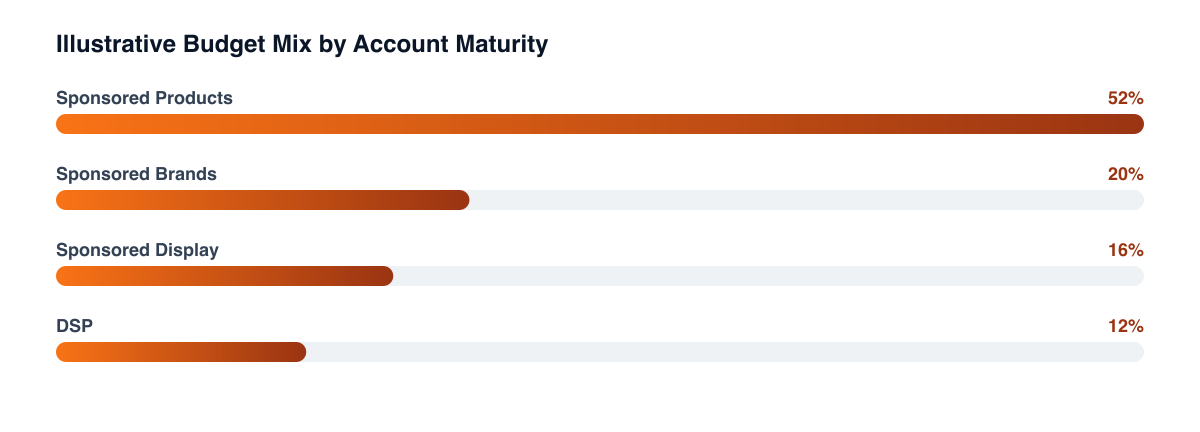
Sponsored Products, Brands, and Display are search- and placement-driven, bought per click, and shown to shoppers already on Amazon with visible intent. They're a harvesting mechanism: you're competing for a query someone already typed.
DSP is programmatic display and video, bought on impressions, capable of reaching audiences on and off Amazon using Amazon's purchase and browsing signals. It's an audience buy, and it behaves like one — slower to read, weaker last-click attribution, and dependent on having something worth retargeting.
That difference decides the reporting expectation more than anything else. Judging DSP on the same ACoS window you use for Sponsored Products will make it look like a failure regardless of whether it worked.
What has to be true before DSP makes sense?
Four things, and the order matters:
- The listing converts. DSP sends traffic to a detail page. If that page underperforms, you're paying to expose a conversion problem to a wider audience — fix listing optimization and A+ content first.
- You hold the Buy Box reliably. Traffic arriving at a listing where a reseller owns the box is spend routed to someone else's revenue. Buy Box stability is a prerequisite, not a parallel workstream.
- Sponsored Products is genuinely saturated. Not "expensive" — saturated. If your search term reports still show profitable terms you're not fully covering, that budget outperforms DSP every time.
- Inventory can absorb it. Going out of stock mid-flight wastes the audience you just built and damages organic rank at the same time.
What is DSP actually good at?
Three jobs it does better than anything else in the marketplace stack. Retargeting detail-page viewers who didn't buy, which is the closest DSP gets to a direct-response channel and where most accounts should start. Reaching competitor-product audiences, which no Sponsored placement can do at comparable scale. And re-engaging past purchasers for replenishment, which is the highest-margin audience available and the one brands most often ignore because it feels like it should be email's job.
Note the shape of all three: they're audiences defined by behaviour that already happened. That's why DSP without traffic to retarget disappoints — it needs a pool, and the pool comes from search.
Set a separate measurement window before you launch DSP's contribution shows up over a longer window than a click-based channel. Agree the window, the metric, and the test duration in advance, or the first monthly review will kill it on the wrong evidence.
How do you read whether it worked?
Not on last-click ROAS alone. The useful reads are new-to-brand order share, total account revenue against total ad spend across both channels, and whether Sponsored Products efficiency improved while DSP ran — a genuine halo shows up as cheaper conversions on search, because the audience arrives warmer.
Be sceptical of any measurement that only ever attributes upward. The honest version of this analysis needs a period without DSP to compare against, which means planning a holdout rather than running the channel continuously from day one. That's the same discipline as any incrementality test — inconvenient, and the only way to know.
Related guides
- Amazon PPC: Campaign Structure That Reduces ACoS
- Amazon Marketplace for D2C Brands: The Complete 2026 Guide
- Winning the Amazon Buy Box: What Actually Moves the Needle
- Amazon vs. DTC: Where Should Your Brand Sell in 2026?
DSP is a scaling tool for accounts that have run out of demand to harvest, not a fix for accounts that haven't harvested it yet. Check the four prerequisites honestly before shifting budget in any marketplace management plan.
PART OF OUR SERVICE
Marketplace Management
Want a free marketing audit?
We'll review your tracking, ad accounts, and funnel — and show you exactly where the gaps are.
Get Your Free Audit →