
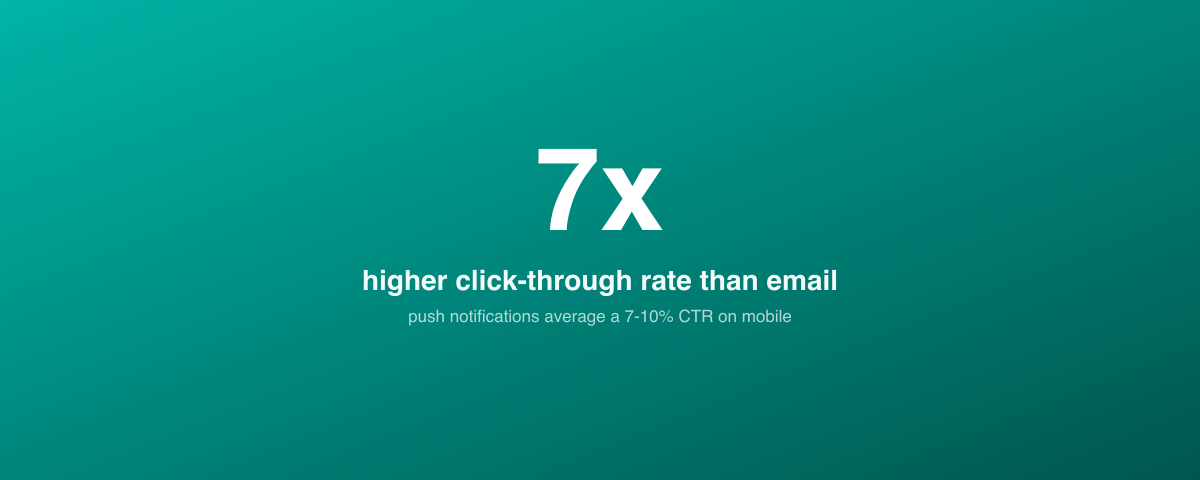
Push notifications average a 7–10% click-through rate on mobile — roughly 7x higher than email. Yet most D2C brands use this channel to blast "20% off everything" to their entire subscriber list and then wonder why their unsubscribe rate climbs to 15% within a month. That range, and the rest of the figures here, come from push programs we've audited rather than a vendor benchmark report.
The problem isn't push as a channel. The problem is treating push like a cheaper version of email marketing.
"The problem is treating push like a cheaper version of email marketing."
— Nitesh Kasma, Co-Founder — Brand Strategy & Client Growth
Why do most D2C push strategies fail?
Three mistakes account for 80% of failed push programs:
Blasting everyone. A new subscriber who bought once six months ago and a loyal customer who buys monthly have nothing in common. Sending them the same promotional message wastes spend and burns trust.
Zero timing logic. Sending a "complete your purchase" notification at 2am local time is not retention marketing — it's an invitation to opt out. Most brands send at internal-team-convenient times rather than customer-behaviour-informed windows.
Using push as a promotional megaphone. Discounts and sales have their place. But if every push is a promotion, you've trained your subscribers to mute you unless they want a deal. When you need to drive a full-price purchase, you have no credibility left.
If you're building a broader owned-channel stack, this fits into the wider CRM & retention picture alongside email and SMS — and it's worth reading D2C Retention Marketing: Email, SMS, and Owned Channels That Drive Repeat Revenue before standing up your push infrastructure.
Web push vs. app push: which should you prioritise?
App push reaches customers who've downloaded your mobile app. Opt-in rates are typically 45–60% among app users. Rich media, deep-link support, and persistent badge counts make it the more powerful format.
Web push works in browsers — desktop and mobile — without an app. Opt-in rates are lower (5–15% of site visitors is typical), but your addressable audience is your entire website traffic base, not just app installers.
For most D2C brands doing under $20M in annual revenue: start with web push. App development requires sustained investment. Web push can be live in under a week via tools like Klaviyo, OneSignal, or Attentive — and begins collecting subscribers immediately.
Once you cross the threshold where a mobile app makes commercial sense, shift primary investment to app push. Retention rates for opted-in app users are 2–3x higher than web push subscribers over a 12-month window.
What 4 push notification types actually retain customers?
Forget the promotional blast. These are the four automation triggers that deliver measurable retention value:
1. Back-in-stock alerts Customers who opted into a restock notification already told you what they want. Conversion rates on back-in-stock push average 12–18%, compared to 2–3% for a promotional blast. Send within 15 minutes of restock. Include the product image, price, and a single CTA.
2. Browse abandonment A customer who viewed a product page three times in 48 hours is not casually browsing. They're undecided. A well-timed push — sent 2–4 hours after their last browse session — converts at 6–9%. Use copy that references the specific product, not a generic "you left something behind" message.
3. Post-purchase re-engagement The window between first and second purchase is where D2C brands lose most customers. A post-purchase push sequence — day 7 with usage tips, day 21 with a complementary product recommendation, day 45 with a replenishment prompt if the category fits — can lift second-purchase rate by 15–25%.
4. Loyalty milestones "You're 200 points away from Gold status" or "You've been a customer for one year" notifications have open rates above 20%. They reinforce identity and create micro-commitment. Pair these with a clear action — earn points, redeem a reward — rather than a generic congratulations.
What's the optimal frequency and timing by category?
General benchmarks by vertical:
- Apparel/fashion: 2–3x per week max. Best windows: Tuesday–Thursday, 10am–12pm and 7pm–9pm local time.
- Beauty/skincare: 3–4x per week. Replenishment categories tolerate slightly higher frequency. Morning send windows perform well (8am–10am).
- Home goods/furniture: 1–2x per week. Lower purchase intent windows — avoid weekends unless running a genuine sale.
- Food/beverage/CPG: Up to daily for subscriptions. 11am–1pm (pre-lunch) and 4pm–6pm (pre-dinner) outperform.
Frequency caps matter. A hard cap of 5 push notifications per week per subscriber, regardless of how many triggers fire, reduces churn without meaningfully hurting revenue. Build this into your platform settings, not as an afterthought.
How do you segment your push list by behaviour?
Batch-and-blast push is dead. Segment by at least three dimensions:
Last purchase date. Customers who bought in the last 30 days should receive product education and usage content. 30–90 days: re-engagement and replenishment. 90+ days: win-back with a meaningful offer or product update hook.
Browse history. A customer who consistently looks at one product category but buys another is signalling an unmet need. Segment for cross-sell push sequences against this pattern.
LTV tier. Your top 20% of customers by lifetime value deserve a different cadence and content mix than one-time purchasers. High-LTV customers tolerate — and often appreciate — more frequent communication when the content is relevant. One-time buyers need more careful handling. Push them too hard and they churn for good.
Combining LTV tier with recency creates eight to twelve segments that cover most D2C scenarios without requiring advanced data infrastructure.
How do you A/B test push copy and timing?
Push copy tests should isolate one variable per test. The highest-leverage variables, in order:
- Send time — Test 10am vs. 7pm for the same message to the same segment. Time-of-day differences often produce 30–40% variance in CTR.
- First line copy — On most devices, the first 40–50 characters are what the customer sees before deciding to tap or dismiss. Test urgency vs. curiosity vs. benefit-led openings.
- CTA specificity — "Shop now" vs. "See your recommendation" vs. "Claim your reward" — specificity consistently outperforms generic CTAs.
Run tests for a minimum of 1,000 impressions per variant before calling significance. Push audiences are smaller than email lists — underpowered tests produce misleading results.
How do you measure push beyond open rate?
Open rate is a vanity metric in push. The four numbers that matter:
Attributed revenue per subscriber. Divide total push-attributed revenue by active subscribers. Track this monthly. Anything above $2–3/subscriber/month on web push is solid; app push should clear $8–12.
Click-through rate by sequence type. Transactional pushes (back-in-stock, order updates) should hold 8%+ CTR. Behavioural triggers (browse abandonment) should be 5–8%. Promotional blasts below 3% are a signal to stop or restructure.
Unsubscribe rate as a health signal. A healthy push program runs below 0.3% unsubscribe per send. Anything above 0.5% consistently means you're either sending too often, to the wrong segments, or with irrelevant content. Don't suppress this metric — it's the earliest warning sign you have.
Revenue influence vs. last-click attribution. Push rarely gets last-click credit because customers often see a notification, close it, and return via direct or paid later. Run 30-day holdout tests quarterly to measure true incremental lift rather than relying on last-click numbers.
For brands also running SMS and WhatsApp Marketing for D2C, push sits in the middle of the urgency spectrum — less intrusive than SMS, faster than email. The channel sequencing should reflect that.
The bottom line
Push notifications outperform every other owned channel on open rate, but most brands squander that advantage by treating push as a promotional broadcast instead of a behaviour-triggered retention tool. Segment by recency, LTV, and browse behaviour, build automation around the four high-converting trigger types, and measure attributed revenue per subscriber — not just opens. That's the gap between a push program that annoys and one that compounds.
Related guides
PART OF OUR SERVICE
CRM & Retention
PROOF FROM A CLIENT
+45% repeat purchase rate
from 22% to 32% of customers purchasing again within 90 days · Beauty & Personal Care
How a Beauty D2C Brand Lifted Repeat Purchase Rate by 45% with a Loyalty Program Rebuild→Want a free marketing audit?
We'll review your tracking, ad accounts, and funnel — and show you exactly where the gaps are.
Get Your Free Audit →