
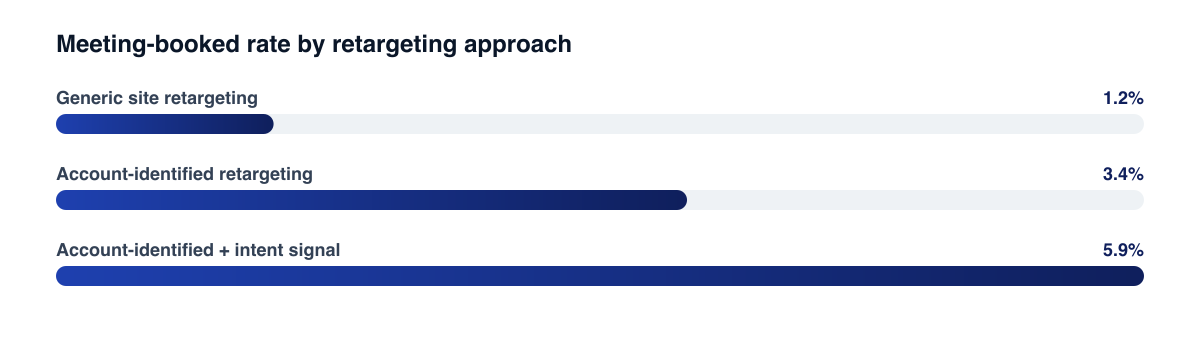
The vast majority of B2B website traffic leaves without ever filling out a form, and standard retargeting treats all of it identically — the same ads, to the same anonymous cookie pool, regardless of whether that visitor works at a target account or is nowhere near your ICP. Intent data and account identification exist to close exactly this gap.
What does "intent data" actually mean in practice?
The term covers two genuinely different things that get conflated constantly:
- First-party intent — behavior on your own site and product: pricing page visits, repeat sessions, feature page depth. This is the highest-signal, lowest-cost intent data you have, and most teams underuse it before buying anything external.
- Third-party intent — aggregated research behavior across a data provider's network, showing which companies are actively researching topics related to your category, even before they've visited your site at all.
The order that saves budget Build first-party intent scoring — pricing page visits, return visits, content depth — into your lead scoring model before paying for third-party intent data. A meaningful share of "which accounts are in-market" questions can be answered from data you already collect.
How do you identify the accounts behind anonymous traffic?
Account-level website identification tools (resolving company identity from IP and firmographic signals, not individual-level tracking) let a B2B team see which named accounts are visiting the site, even pre-form-fill. This is what makes account-based retargeting possible — without it, retargeting can only follow an anonymous cookie, not a company.
How do you build the retargeting sequence around account status?
Once accounts are identifiable, retargeting stops being one undifferentiated pool and becomes a set of distinct plays:
- Target accounts already in your CRM as open pipeline with sales-aligned messaging — case studies and proof points relevant to their specific stage, not top-of-funnel awareness content.
- Target identified accounts matching your ICP but not yet in pipeline with problem-awareness content, aimed at getting a form fill or a sales-accepted signal, not an immediate demo request.
- Exclude accounts that don't match ICP firmographics from paid spend entirely, even if they're generating traffic — account identification is as valuable for suppression as it is for targeting.
- Layer third-party intent signal on top of account identification only for accounts that already match your ICP — intent data on a bad-fit account is not worth acting on regardless of how strong the signal is.
The trap to avoid Account identification tools generate a long list of company names visiting the site, and it's tempting to treat every one as a lead. Most of that traffic is still low-intent — vendors, students, competitors doing research. Filter hard on ICP fit before any of it reaches sales or triggers a retargeting spend.
Related guides
- Account-Based Marketing (ABM): The Playbook for Mid-Market B2B Brands
- B2B ICP Definition and Targeting: Building the Filter Before the Funnel
- Marketing Automation and Lead Scoring for B2B
- B2B LinkedIn vs. Google Ads: Choosing the Right Channel by ACV
Intent data and account identification don't replace a solid ICP definition — they make it actionable earlier in the funnel, surfacing the right accounts before they've raised their hand.
"Intent data and account identification don't replace a solid ICP definition — they make it actionable earlier in the funnel, surfacing the right accounts before they've raised their hand."
— Nitesh Kasma, Co-Founder — Brand Strategy & Client Growth
Without a tight ICP filter behind it, though, the same tooling just generates a longer list of accounts to ignore. Most of our B2B lead generation work starts by narrowing that account list first, because signal applied to a loose ICP just scales the noise.
PART OF OUR SERVICE
B2B Lead Generation
PROOF FROM A CLIENT
$340K pipeline
quarterly qualified pipeline from near zero · SaaS / Technology
How a B2B SaaS Company Built a $340K Quarterly Pipeline→Want a free marketing audit?
We'll review your tracking, ad accounts, and funnel — and show you exactly where the gaps are.
Get Your Free Audit →