

Most D2C accounts treat Demand Gen and Performance Max as two flavours of the same thing, then wonder why adding one makes the other look worse. They're not interchangeable: one is built to put your product in front of people who weren't looking, the other to convert people who were.
"If both campaigns are asked to prove themselves on last-click conversions, the one closer to the purchase always wins — and you end up cutting the one that was feeding it."
— Dhruvit Shah, Co-Founder — Performance Marketing & Growth Strategy
What is each campaign type actually built to do?
Google describes Demand Gen as a way to reach people in a discovery mindset on its visual surfaces: YouTube (including Shorts), Discover, Gmail, and the Google Display Network. It supports audience targeting such as lookalike segments, creative experiments, and product feed ads.
Performance Max runs across YouTube, Display, Search, Discover, Gmail, and Maps from a single campaign, and treats the audience signals you provide as guidance rather than hard limits. The practical difference: Demand Gen lets you choose who sees the ad and what it looks like; Performance Max chooses for you and optimises toward the conversion goal. For the full setup playbook on the latter, see our Performance Max guide.
Where do they overlap, and why does that cause trouble?
Both can serve on YouTube, Discover, and Gmail, so both can reach the same person. Performance Max also has Search and Shopping inventory. In our experience, that lower-funnel inventory often ends up with the final click on someone Demand Gen introduced earlier, though this is a practitioner observation, not something Google documents, and it will vary by account. Read in isolation, Demand Gen then looks expensive and Performance Max looks like a hero.
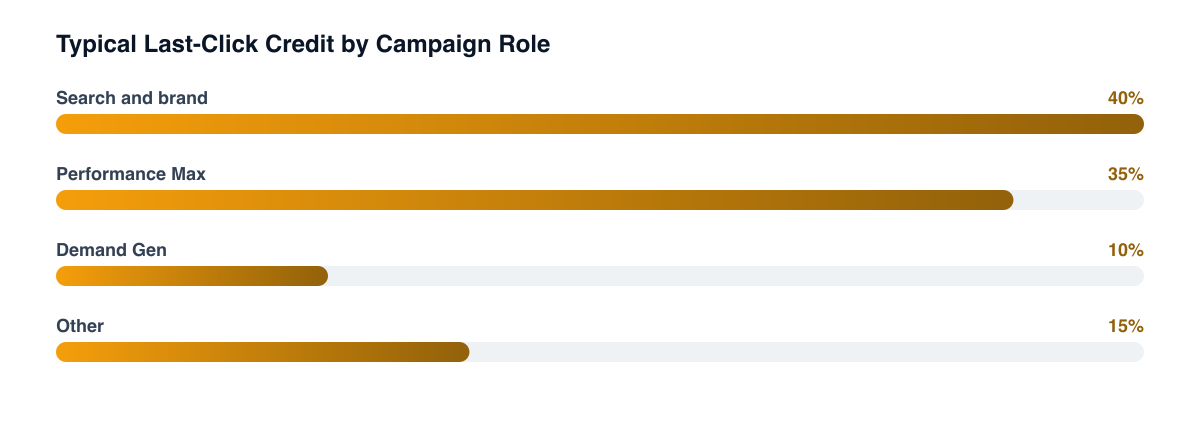
The numbers above are illustrative, not benchmarks, but the shape is common: the campaign that creates demand rarely gets paid for it under last-click. This is the same attribution trap covered in attribution modeling, and it's the main reason Demand Gen gets cut early.
When should a D2C brand lead with Demand Gen?
Lead with it when the problem is upstream, not at conversion:
- A new or niche product that people don't search for by name yet.
- Strong video or visual creative that already works on Meta or TikTok and hasn't been tested on YouTube.
- Search is already saturated — brand and category terms are capped by existing demand, so more bidding won't find more buyers.
- You want controlled audiences, such as lookalikes of your best customers, rather than a system-chosen mix.
When is Performance Max the better first move?
Performance Max is the stronger start when you have a clean product feed, reliable conversion tracking, and enough purchase volume for automated bidding to learn from. It's the broadest net and the least setup, which suits catalogue brands with many SKUs. It's weaker when you need to control exactly where and to whom you show, which is Demand Gen's strength. Neither replaces a well-built Google Shopping structure if you need SKU-level control.
Give each campaign a different job and a different scorecard Judge Demand Gen on new-customer reach, engaged views, and assisted conversions; judge Performance Max on conversion value against its target. Never ask one to hit the other's number.
How do you run both without them fighting?
- Separate budgets, not a shared pool. A fixed Demand Gen allocation stops Performance Max from absorbing it.
- Use brand exclusions in Performance Max (Google documents these as a way to limit unwanted queries) so it isn't claiming searches your brand campaign already owns.
- Keep audiences distinct. Feed Demand Gen cold lookalikes; keep existing customers and warm lists to Performance Max, or exclude them from both if you're after new buyers.
- Measure incrementality, not just platform ROAS. A geo holdout test tells you whether Demand Gen is adding sales or only re-labelling them.
- Change one thing at a time and allow time for each campaign to learn before reading results.
None of this is a guarantee that Demand Gen will pay back in your account; it won't for every brand, especially with thin creative or low volume. Treat it as a defined test with a pre-agreed read, not a permanent line item.
Related guides
- Performance Max Campaigns: A Practical Guide for D2C Brands
- Google Ads for D2C: The Complete Guide
- Google Shopping Campaign Structure
- Geo-Holdout Incrementality Testing
Choosing between the two is really a question of where your funnel is weakest, and that's a measurement problem before it's a campaign problem. If you want a second pair of eyes on how your Google mix is structured, our performance marketing team can help.
Want a free marketing audit?
We'll review your tracking, ad accounts, and funnel — and show you exactly where the gaps are.
Get Your Free Audit →