
Brand identity is one of those terms that gets used to justify expensive agency retainers and elaborate brand books no one ever reads. For a D2C brand, it's actually something much more practical: a system of visual and verbal cues that makes your ads recognizable before anyone reads the headline.
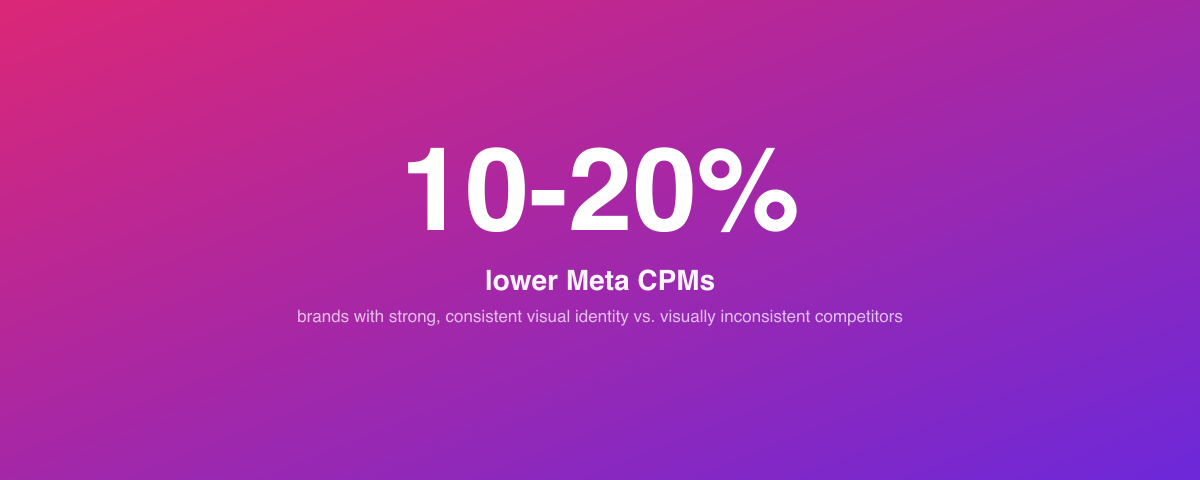
That recognition has a direct dollar value. Brands with strong visual consistency see 10–20% lower CPMs on Meta because the algorithm rewards content that generates quick, positive engagement signals. When people recognize your brand in the first 0.5 seconds of a scroll, they stop more often — and stops are what drive down costs.
What actually is brand identity (and what isn't it)?
Brand identity is not your mission statement. It's not your values deck. It's the tangible system of elements — logo, color, typography, photography style, voice — that makes every piece of content feel like it came from the same place.
Brand identity is the execution layer. Brand positioning is the strategic layer — who you're for, what you stand for, why you're different. You need both, but they're not the same thing. A lot of D2C brands get this backwards: they spend months on positioning workshops and launch with inconsistent creative that undermines everything.
The practical test: if you strip the logo off one of your ads, can a customer still tell it's yours? If not, you don't have a brand identity yet — you have a collection of assets.
What are the five core components?
Every D2C brand identity system needs five elements: logo, color palette, typography, photography style, and voice/tone. Miss any one and the system breaks down.
Logo. Your logo needs to work at thumbnail size — because that's often where people will see it first. A complex wordmark that looks beautiful on a billboard becomes unreadable in a 40px mobile nav. Build for the smallest context first.
Color palette. The most underused growth lever in D2C. A distinctive, ownable color (or color combination) creates pattern recognition that works even in feed environments where text is never read. Pick 2–3 primary brand colors and 1–2 accent colors. Enforce ruthlessly.
Typography. Two to three fonts maximum. A headline font that carries personality, a body font that's purely functional, and optionally a display or accent font for callouts. Typography drift — where designers keep introducing new fonts — is one of the fastest ways to erode brand coherence across a team.
Photography style. This is where most D2C brands have the most inconsistency. Define your visual world clearly: lighting style (bright and airy vs. moody and editorial), shooting environment (lifestyle vs. studio vs. UGC aesthetic), color grading, and model/talent direction. The guide for UGC vs. Studio Creative goes deep on how these choices interact with performance.
Voice and tone. Write down the 3–5 adjectives that describe how your brand sounds. Then write examples of what that sounds like in copy — and what it explicitly doesn't sound like. "Friendly but not sycophantic. Confident but not arrogant. Direct but not cold." Without examples, these adjectives mean nothing to a copywriter who's never worked with your brand before.
How does visual identity affect ad performance?
The mechanism is straightforward: brand recall reduces friction at every stage of the funnel.
A customer who's seen your ads 4–5 times and recognizes your visual style will have meaningfully higher CTR than a cold audience seeing your brand for the first time — even if the ad creative is identical. Retargeting audiences typically show 2–4x higher CTR than cold audiences, and a big part of that is brand familiarity doing the work.
More importantly, when you run creative testing, strong brand consistency means you're isolating variable performance to the actual creative elements you're testing (hook, offer, format) rather than noise from visual inconsistency. Brands with weak identity get muddy test results because their "brand" is functionally different across ad sets.
There's also a cost effect over time. As brand recognition builds, you spend less on frequency to achieve the same recall. Brands in the 12–24 month range with consistent identity typically see 15–25% lower CPMs than comparable brands with inconsistent visual presentation, holding everything else equal.
How do you build guidelines that people actually use?
Most brand guidelines fail because they're built for presentations, not for working creative teams. A 60-page PDF with kerning specifications and color philosophy essays will sit unopened in a Dropbox folder.
Build for speed and clarity instead:
- One-page quick reference with hex codes, font names, logo clearspace rules, and 3–4 "approved look" examples
- Do/don't image examples for photography style — showing is faster than describing
- Tone examples in real contexts — ad headline, email subject line, product description, customer service reply
- Asset library with pre-built templates for the most common formats (feed ad, story ad, email header)
If a freelancer or new agency can get up to speed in under 30 minutes without a call, your guidelines are working. If they need to ask 10 questions before they can produce a single asset, rewrite them.
This is especially important for creative & branding work done externally — the quality of your brief determines the quality of the output. Vague guidelines produce vague creative.
What's the difference between brand identity and brand positioning?
These two things work together but get confused constantly.
Positioning answers: Who is this for, what problem does it solve, and why is it better than alternatives? It lives in strategy documents and informs messaging hierarchy.
Identity answers: What does this look like, sound like, and feel like? It lives in design files, style guides, and content templates.
You can have sharp positioning and weak identity (great strategy, inconsistent execution). You can have strong identity and weak positioning (looks beautiful, but no one knows why they should care). The brands that scale efficiently have both — the identity amplifies the positioning by making it instantly recognizable.
When does your identity need a refresh?
A brand refresh is not a rebrand. A refresh tightens, modernizes, or clarifies. A rebrand changes the foundation. Most D2C brands need refreshes far more often than they need rebrands.
Signs you need a refresh:
- Your creative team regularly goes off-brand because the guidelines don't cover new formats (Reels, TikTok, connected TV)
- Your brand looks dated relative to your current price point or target customer
- You've expanded into new categories and the original visual language doesn't stretch
- CTRs and thumbstop rates have declined across creative types for 60+ days with no clear hook/offer explanation
Signs you might need a rebrand:
- Your positioning has fundamentally shifted (different customer, different problem, different competitive set)
- Brand association is actively working against you (prior baggage, category perception issues)
Most brands that think they need a rebrand actually need better guidelines and more disciplined execution of what they already have.
The bottom line
Brand identity is not a creative luxury — it's a performance lever that compounds over time.
"Brand identity is not a creative luxury — it's a performance lever that compounds over time."
— Nitesh Kasma, Co-Founder — Brand Strategy & Client Growth
The brands that build consistent, recognizable visual systems early pay less to acquire customers later, because recognition does work that paid media otherwise has to do. Build the system, enforce it, and test everything within it.
Related guides
PART OF OUR SERVICE
Creative & Branding
Want a free marketing audit?
We'll review your tracking, ad accounts, and funnel — and show you exactly where the gaps are.
Get Your Free Audit →