
The brands winning on paid social right now aren't necessarily spending more — they're iterating faster. And the gap between brands producing 5 creatives per month and brands producing 50 is increasingly an AI story.
AI hasn't changed what makes creative work. Hook strength, emotional relevance, product clarity — those still determine performance. What AI has changed is how quickly you can go from brief to testable asset, and how cheaply you can generate the volume needed to find winners.
Here's what's actually working for D2C brands in 2026.
Which tools are delivering real production lift?
Most of the credible AI production stack falls into four categories:
Image generation and iteration. Midjourney, Firefly, and DALL-E 3 have become standard for lifestyle mockups, background swaps, and seasonal variants. A product shot that used to require a $3,000 studio day can now be reskinned into 10 scene variations in a morning. The output isn't always perfect, but it's good enough to test — and that's the point.
Video editing and repurposing. Tools like Runway, Kling, and CapCut's AI suite are changing the math on video production. A single 60-second hero video can be repurposed into 15-second cuts, resized for different placements, dubbed in multiple languages, and reformatted for TikTok vs. Reels — in hours rather than days. Brands running Meta Ads for D2C with multiple placements are getting the most mileage here.
Script and copy assistance. Claude, GPT-4o, and purpose-built tools like Copy.ai are being used to generate first-draft scripts, headline variations, and body copy at scale. The key word is "first draft" — the best practitioners use these outputs as raw material, not finished assets.
Creative analytics and signal reading. Tools like Motion, Foreplay, and Marpipe are using AI to analyze which creative elements — hooks, formats, color palettes, CTAs — are driving performance, and feeding those signals back into the brief. This closes the loop between testing and production faster than any human analyst can.
What is AI genuinely good at?
Be specific about where AI adds value so you don't misapply it.
AI excels at: volume production, format adaptation, variation generation, first-draft copy, background and scene swaps, subtitle and caption generation, and pattern recognition across large creative datasets.
These are high-frequency, low-judgment tasks where the cost of being wrong is low. If an AI-generated headline variant doesn't perform, you've lost 10 minutes. If an AI-generated background swap looks off-brand, you catch it in QA and discard it.
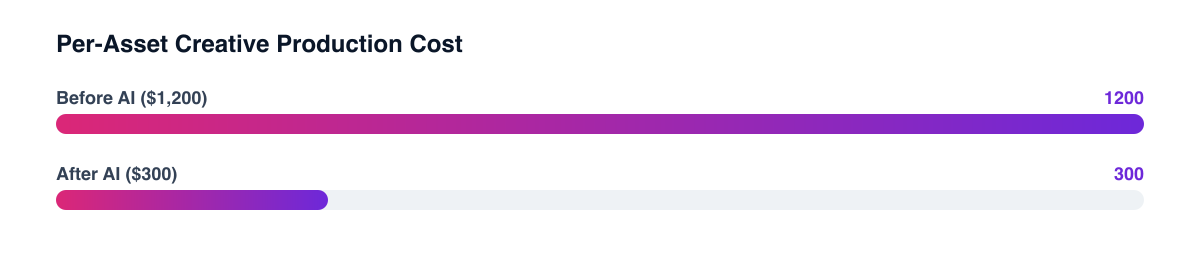
The production time savings are real: brands that have systematically adopted AI-assisted workflows report 40–60% reductions in time-to-publish for creative assets, with some teams cutting per-asset costs from $800–1,200 down to $150–300.
Where does human judgment remain irreplaceable?
The failure mode most brands encounter is treating AI as a strategy tool rather than a production tool.
AI has no concept of what makes your brand distinct. It doesn't know that your customer skews 28–34, that they respond better to problem-framing than aspiration, or that your competitor just launched a campaign that looks exactly like the output you're about to push. It can't feel cultural tension or spot when a concept is going to land wrong.
Strategy, brief-writing, and creative direction are not AI tasks. Neither is brand voice calibration — the thing that makes your ad feel like yours rather than a generic DTC template.
The creative & branding work that actually moves the needle — identifying the insight, deciding what angle to push, knowing when to break from the formula — requires a human who understands your brand, your customer, and the competitive context. AI amplifies that thinking. It doesn't replace it.
Cultural relevance is the other hard limit. AI-generated creative trained on historical data will always lag behind real-world moments. Timeliness, cultural nuance, and knowing when something is going to fall flat require human judgment that no model has consistently delivered.
How do you build an AI-assisted creative workflow?
The brands getting the most from AI have structured their process clearly rather than sprinkling AI tools randomly into existing workflows.
The working model: Strategy → Brief → AI-assisted production → Human QA → Launch → Analyze → Feed signals back to brief
Here's what each stage looks like in practice:
Strategy and brief. A human (or a small team) defines the hypothesis: what angle, what audience segment, what format, what objective. This is where 80% of the creative value gets determined. The brief should specify tone, visual direction, and the specific claim or hook being tested.
AI-assisted production. The brief goes into the production stack. Image tools generate visual variants. Copy tools generate headline and body text options. Video tools handle resizing and format adaptation. The goal is raw material, not finished ads.
Human QA. A creative lead reviews every asset before it goes live. This is not optional. AI output fails in specific ways — brand inconsistency, subtle visual errors, tone drift — that require human review to catch. Budget 20–30 minutes of QA time per batch, not per asset.
Launch and analyze. Assets go live. Performance data flows back into Motion or your analytics layer. You're looking for hook rate, scroll-stop performance, and downstream conversion signals.
Signal feedback to brief. This is where most teams leave money on the table. The data from your tests should be rewriting your next brief. If the problem-aware hook outperformed the aspirational hook by 2.3x, that's your input for the next production cycle. Pair this with a structured creative testing framework and you build compounding advantages over time.
How do you maintain brand consistency at scale?
More volume means more opportunities for brand drift. The guardrails that work:
A locked brand kit in every AI tool. Custom models fine-tuned on your brand's visual output consistently outperform generic prompting. Most mid-size D2C brands now maintain a brand-specific model or at minimum a detailed style guide fed into every generation prompt.
Mandatory human review before anything goes live. This sounds obvious but gets eroded under time pressure. The QA step is non-negotiable.
Templatized briefs with locked brand parameters. If every brief includes the same brand voice guidelines, visual constraints, and tone flags, the AI output will drift less. Treat the brief as a system input, not a creative document.
The competitive implications
Here's the uncomfortable truth: AI has lowered the barrier to production volume for everyone. The brand that was winning because they could afford a full creative team now faces competition from a three-person operation running an AI-assisted workflow.
That means competitive advantage shifts back to strategy, data, and taste. The teams that will pull ahead aren't the ones using the most AI tools — they're the ones with the sharpest creative hypotheses, the tightest feedback loops, and the discipline to keep human judgment at the center of the process.
Volume without a testing system is just noise. Pair your production capacity with a structured testing process and a clear read on what the data is telling you, and the output differential becomes a real moat.
The bottom line
AI removes the production bottleneck that was the primary constraint on creative testing — but it doesn't remove the need for strong creative strategy, brand judgment, or disciplined analysis.
"AI removes the production bottleneck that was the primary constraint on creative testing — but it doesn't remove the need for strong creative strategy, brand judgment, or disciplined analysis."
— Nitesh Kasma, Co-Founder — Brand Strategy & Client Growth
The D2C brands scaling output in 2026 are using AI for what it's genuinely good at and keeping humans in the decisions that actually determine whether creative works. The teams treating AI as a production layer rather than a strategy replacement are the ones building durable advantages.
Related guides
PART OF OUR SERVICE
Creative & Branding
Want a free marketing audit?
We'll review your tracking, ad accounts, and funnel — and show you exactly where the gaps are.
Get Your Free Audit →