
The AI tools conversation in D2C marketing has bifurcated into two camps that are both wrong. One camp treats AI as a magic layer that will eventually automate everything and make performance marketing a solved problem. The other camp dismisses AI tools as hype layered on top of the same fundamental channel mechanics. The reality is more specific and more useful: there are particular use cases where AI tools are delivering measurable, compounding improvements to marketing performance, and other use cases where they add complexity without proportionate return.
"There are particular use cases where AI tools are delivering measurable, compounding improvements to marketing performance, and other use cases where they add complexity without proportionate return."
— Dhruvit Shah, Co-Founder — Performance Marketing & Growth Strategy
After 18 months of running AI-augmented campaigns across paid media, creative, and analytics, here's the honest breakdown.
Where is AI delivering real returns?
Creative generation and testing velocity
The single highest-return AI application in D2C marketing is creative production speed. A brand that used to produce 8–12 ad creative assets per month can now produce 40–60 with the same team, using AI generation tools for copy variations, background removal, image remixing, and video scripting.
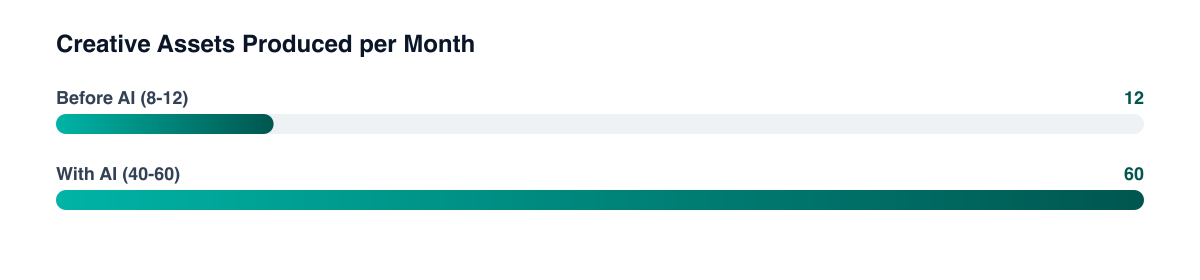
The return is not from the AI creative being better than human-produced creative — it isn't, in most cases. It's from testing volume. Creative is the highest-leverage variable in Meta and TikTok campaigns; the algorithm's ability to find winning creative depends on having enough variants to test. A brand testing 8 creatives per month will find a winner every 6–8 weeks. A brand testing 40 will find one every week or two. The compounding effect of faster creative iteration shows up directly in blended ROAS over a 6–12 month period.
Tools that are actually useful here: Midjourney and Firefly for product and lifestyle image generation, ElevenLabs for ad voiceover at scale, Captions for AI video editing and B-roll generation, and Claude or GPT-4o for ad copy variations and hook writing. The workflow is AI-assisted production with human quality control and creative direction — not full automation.
What to watch out for: AI-generated images that look uncanny or generic erode brand equity. The volume advantage disappears if the creative feels off-brand. Keep a human creative director in the loop for anything customer-facing.
Predictive audience segmentation
Klaviyo, Attentive, and most modern CDPs now include ML-based predictive features: predicted LTV, churn probability, next-purchase date, and product affinity scoring. These models run on your own first-party purchase and engagement data and are genuinely useful for segmentation precision.
The practical application: instead of segmenting your email list by "hasn't bought in 90 days," you segment by "high churn probability score in Klaviyo." The second segmentation is more accurate because it weighs multiple signals simultaneously — engagement decay, purchase recency, historical frequency, and behavioral signals — rather than a single time-based threshold.
Brands that have migrated to predictive segmentation in their CRM and retention flows see 15–25% improvement in flow conversion rates without changing the copy or offer. The improvement is entirely from targeting the right people at the right time.
AI bidding on Google and Meta
Both platforms' automated bidding (Meta's Advantage+ budget optimization, Google's Smart Bidding) are forms of ML that have been in production long enough to be genuinely better than manual bidding in most scenarios. This is not a controversial claim in 2026 — the data is clear. The platforms' ML models process millions of signals (time of day, device, user behavior history, auction context) at a granularity that's impossible to replicate manually.
The nuance: automated bidding requires you to give the algorithm high-quality conversion signals to optimize toward. If your Meta pixel is undercounting conversions because of iOS signal loss, Meta's ML is optimizing toward a degraded signal and will underperform. If your Google conversion tracking is missing offline conversions or phone calls, Smart Bidding will underbid for users who call rather than click.
The correct approach is to treat AI bidding as a dependency on signal quality rather than a substitute for it. Investing in server-side tracking, CAPI integration, and conversion import from CRM data to the ad platforms isn't just a tracking fix — it's improving the inputs to the ML models that control your spend. Better signal quality is directly multiplicative with AI bidding performance.
Ad copy generation at scale
AI copywriting tools have matured to the point where they're genuinely useful for generating the long tail of ad copy variations that human copywriters don't have bandwidth to write. The use case is not "have AI write the hero ad" — it's "have AI write 15 variations of the hook for a human to select from and refine."
The workflow that works: a human writes the brief (product, audience, benefit, tone, format), AI generates 10–20 variations, a human selects the strongest 3–4 and edits them to brand voice, and those go into testing. The human's judgment is applied at brief-writing and selection/editing, not at generation. This process produces 3–5x more testable copy variants per hour of human creative time.
For brands advertising at scale, this matters because copy variation is underexplored relative to visual creative. Most brands run 2–3 copy variants against 8–10 visual variants. The optimization surface is asymmetric. Running 8–10 copy variants against the same visual pool can produce meaningful performance gains from the copy variable alone.
Where is AI overhyped?
Fully automated creative production
End-to-end AI creative — where a tool generates the concept, the visual, the copy, and the final asset without human intervention — produces mediocre output at high volume. Generic product ads on white backgrounds, voiceovers that don't match brand personality, and copy that reads competently but blandly. These ads test fine against each other but lose to human-crafted creative whenever the competition is human-crafted.
The brands winning on creative in 2026 are using AI to accelerate and scale a human creative vision, not to replace it. The creative brief, the hook concept, the brand voice, the hero shot direction — these remain human-led decisions. AI handles iteration and production of what's already been defined.
AI agents for campaign management
There's a category of tool claiming to automate campaign management — adjusting budgets, pausing underperforming creatives, shifting spend across channels — with AI agents. In practice, these tools either automate decisions that are already automated by the platform's native ML (redundant), or they automate decisions that require context the agent doesn't have (dangerous).
A budget-shifting agent that sees "Meta ROAS dropped 20%" and moves budget to Google doesn't know whether the Meta drop is because of creative fatigue (fix: new creatives), audience exhaustion (fix: expand audiences), seasonal signal loss (fix: wait), or a tracking issue (fix: debug before moving budget). Acting on the symptom without diagnosing the cause produces worse outcomes than a human checking in daily. These tools are more useful as alerting and reporting systems than as autonomous actors.
AI-generated personalization at the individual level
The vision of 1:1 AI personalization — every customer sees a unique ad creative, a unique landing page, and a unique email flow built from their specific behavioral profile — is technically possible and economically impractical for most D2C brands. The diminishing return from personalization beyond well-executed segment-level targeting is real, but smaller than the production cost of maintaining truly individual-level personalization at scale.
The practical ceiling for most brands is segment-level personalization executed well: distinct messaging for new visitors vs. returning customers, different acquisition creative for different customer personas, distinct email flows for high-LTV vs. low-LTV subscribers. That level of segmentation is achievable with existing tools and delivers the majority of the personalization lift.
What AI stack is actually worth building?
For a D2C brand doing $5M–$50M in revenue, the AI tools worth integrating in 2026 are:
In creative production: an AI image generation tool for asset creation, an AI video editor (Captions or equivalent) for short-form video, and an AI copy assistant (Claude or GPT-4o) for copy variation generation. Budget: $200–$500/month in tool subscriptions. Return: 3–5x creative testing velocity.
In retention and email: Klaviyo Predictive Analytics for churn scoring and LTV prediction, with flows built on predicted segments rather than time-based triggers. This is included in existing Klaviyo pricing above the free tier — no additional tool cost. Return: 15–25% improvement in retention flow conversion rate.
In paid media: full commitment to platform AI bidding (Advantage+, Smart Bidding, Performance Max) with investment in signal quality (CAPI, server-side GTM, conversion import). The AI is already there; the investment is in the inputs.
In analytics: a data warehouse (BigQuery or Snowflake) with a BI tool that uses LLM-assisted query generation (Looker's new AI features, or Mode with AI assist). Not for replacing analysts, but for reducing the time between "business question" and "SQL query" from hours to minutes, which makes the analytics function more responsive.
What's notably absent from this list: AI campaign management agents, fully automated creative pipelines, and complex custom ML infrastructure. All of these have real costs — in money, in maintenance, in the organizational complexity of managing automated systems that can spend money — that exceed their current returns for most D2C businesses.
How do you evaluate AI tool ROI?
The test for any AI marketing tool is: does it improve a metric that matters, and can you measure the improvement against a credible baseline?
For creative tools, the metric is creative testing velocity and winner discovery rate. Run AI-augmented creative production for one quarter and compare the number of winning creatives identified against the prior quarter. The improvement should be measurable.
For predictive segmentation, the metric is flow conversion rate for AI-segmented flows vs. rule-based segmentation. An A/B test with a holdout group gives you clean lift data.
For signal quality investments (CAPI, sGTM), the metric is the percentage of conversion events attributed to paid media before and after implementation. This is measurable through Meta's Event Match Quality score and Google's conversion tag diagnostics.
For bidding automation, incrementality testing against manual bidding baselines is the cleanest measure — though it requires significant test budgets to be statistically powered.
Related guides
- D2C Analytics and Attribution: The Complete Guide to Measuring What Works
- Creative Testing Framework: How to Test Ads Without Burning Budget
- Marketing Budget Allocation: How to Split Spend Across Channels
- Meta Conversions API: The Complete Setup Guide for D2C Brands
The brands that are getting the most from AI tools in 2026 are not the ones that have adopted the most tools. They're the ones that have matched specific tools to specific measurable outcomes and invested deeply in the few places where the evidence is strong. Our performance marketing and data analytics work reflects that same principle — build on what works, measure it, and don't let tool proliferation substitute for strategic clarity.
PART OF OUR SERVICE
D2C Growth Bundle
Want a free marketing audit?
We'll review your tracking, ad accounts, and funnel — and show you exactly where the gaps are.
Get Your Free Audit →