
Affiliate marketing has a reputation problem in D2C. Brands that have tried it often describe the same experience: sign up for a network, recruit some affiliates, watch coupon sites claim attribution for purchases that were happening anyway, and eventually shut it down after realizing the program is cannibalizing margin rather than acquiring new customers. This experience is real and common — and it's the result of running affiliate marketing as a passive channel rather than an active one. The brands with affiliate programs that generate genuine incremental revenue have built something structurally different from what most brands default to. The commission and performance ranges below come from affiliate programs we've audited and rebuilt, not from network-published benchmarks.
What are the two types of affiliate marketing?
Before building a program, it's worth being clear about what type of affiliate marketing you're actually building, because the economics and execution are different.
Coupon and cashback affiliate marketing is what most brands run by default. This involves partnerships with RetailMeNot, Honey, Rakuten, and similar discount and cashback sites. These partners have massive existing audiences of bargain-seeking shoppers. They drive traffic through discount distribution. The attribution model credits the affiliate with the sale when their link or code is used at checkout.
The problem: most of this traffic was already coming to buy. A customer who searched "[brand name] discount code," found one on RetailMeNot, and used it at checkout was going to buy anyway. The affiliate gets a 10–15% commission on a sale you were going to make; you lose 10–15% gross margin. The conversion rate for coupon traffic looks excellent because it's capturing in-market intent, not creating it.
Coupon affiliates can have a role in a program — they can capture price-sensitive customers who wouldn't have converted at full price — but treating them as acquisition partners is incorrect. They're margin-sharing arrangements on existing demand.
Content and creator affiliate marketing is a different animal. This involves partnerships with publishers, bloggers, newsletter writers, YouTube creators, and social media influencers who produce content recommendations to their own audiences. When a creator with 50,000 engaged subscribers recommends your product with their affiliate link, and some of those subscribers convert, that is genuine new-customer acquisition. The creator's audience didn't know about your brand; the creator's endorsement created the intent.
The economics are similar — commissions of 10–20% on referred sales — but the incremental nature of the traffic is fundamentally different. A post-purchase survey asking "where did you hear about us?" will show "from [creator name]'s newsletter" for these customers, not "I was already on the site to buy." That's the distinction.
Most high-performing affiliate programs are primarily content and creator programs with selective coupon affiliate participation. Building a program that confuses the two will produce misleading metrics and disappointing economics.
What decisions matter for program structure?
Commission rate. The commission rate has to be set against your gross margin and desired CAC. A product with 60% gross margins can support a 15–20% commission and still be acquiring customers below a $40–50 CPO. A product with 35% margins cannot. Calculate: (gross margin × AOV) minus (commission rate × AOV) minus COGS equals contribution per affiliate-referred order. This number needs to be positive, and it needs to leave room for repeat purchase economics — an affiliate-referred customer who buys twice is worth significantly more than one who buys once.
For recurring revenue products (subscriptions), affiliate programs often pay a higher one-time commission or a recurring monthly commission for as long as the subscriber remains active. Recurring commissions dramatically increase affiliate motivation — an affiliate who earns $5/month for every active subscriber they referred is incentivized to recommend your subscription to qualified audiences, not just anyone. The total commission payout is higher, but so is the LTV of the acquired customer.
Cookie window. The cookie window determines how long after a click an affiliate gets credit for a conversion. A 30-day window means if someone clicks an affiliate's link today and purchases 20 days later, the affiliate gets credited. A 7-day window means purchases after day 7 don't count. Longer windows reward affiliates for top-of-funnel content; shorter windows favor bottom-of-funnel coupon traffic. For content creators, a 30-day window is standard and appropriate. For coupon affiliates, a 7-day window is more defensible.
Attribution rules for multi-touch. What happens when a customer sees a Meta ad, reads an affiliate's blog post, clicks the affiliate link, and then converts through a retargeting ad? Who gets credit? Most affiliate platforms use last-touch for affiliate attribution, which means the last affiliate click before purchase gets 100% commission credit regardless of whether earlier touches existed. This matters for your economics: if affiliates are converting customers you would have retained through paid retargeting anyway, you're double-counting acquisition costs. Build rules for this — typically, if a purchase occurs within 3 days of a paid ad click, the paid channel attribution takes precedence.
Platform selection
The affiliate platform choice affects both your operational overhead and the type of affiliates you can recruit.
Impact.com is the dominant platform for mid-market and enterprise D2C brands. It handles tracking, commission payouts, partner recruitment, contract management, and fraud detection. Its marketplace allows you to be discovered by affiliates already on the platform. The cost is $500–$2,000/month plus a percentage of affiliate payouts. For brands doing significant affiliate volume, the operational simplicity is worth the cost.
ShareASale (now Awin's US platform) is a larger marketplace with a broader range of affiliates, including many content publishers and bloggers who may not be on Impact. It's lower-cost but more self-managed — you get less support and less sophisticated fraud tools. Good for programs just getting started that want access to a broad affiliate pool.
Rewardful or PartnerStack are simpler SaaS-focused tools that work for D2C brands running straightforward programs. Lower cost, easier setup, fewer features. Appropriate for brands early in program development before volume justifies a full platform investment.
Direct program (no platform). For creator partnerships, some brands manage a direct affiliate program using Shopify discount code attribution rather than a full platform. Each creator gets a unique discount code; Shopify tracks orders using that code; the brand pays commissions monthly based on the order report. This is simple, low-cost, and works for small programs (10–30 creators). It doesn't scale to hundreds of affiliates without significant manual overhead.
Where do you find the right affiliate partners?
Most brands start affiliate recruitment backwards — they post on affiliate networks and wait for applications, then approve whoever applies. This produces a lot of coupon site applications and few qualified content partners. The recruitment strategy that builds a high-quality program is outbound.
Identify existing customer-creators first. The highest-converting affiliates are people who genuinely use your product. Start with your CRM database — anyone who has mentioned your product on social media, left a detailed review, or interacted with your email content enthusiastically. A customer who already loves the product is a more credible promoter than an affiliate who signed up for the commission. Your CRM might have 50–100 customers with social followings who are already advocates; turning them into affiliates formalizes a relationship that already exists.
Search for category-adjacent content creators. A skincare brand should be recruiting beauty journalists, skincare YouTube creators, newsletter writers covering wellness routines, and Reddit moderators of skincare communities. A kitchen brand should be recruiting food bloggers, Substack recipe writers, and cooking YouTube channels. The relevant creator ecosystem exists; finding it requires category-specific search rather than generic affiliate directory browsing.
Tools for finding creators: Modash and Creator.co for Instagram and TikTok creator search by niche, SparkToro for finding publications and newsletters that reach your target demographic, and simple Google searches ("[category] + best products + newsletter" or "[category] + YouTube" + sort by subscriber count).
Target newsletters specifically. Email newsletter creators are systematically undervalued in affiliate programs because their follower counts are lower than social media creators. But newsletter audiences are higher-intent and more likely to act on recommendations because they opted into receiving content from a specific creator. A newsletter with 15,000 subscribers and a 35% open rate will often outperform an Instagram account with 150,000 followers and 1% engagement on affiliate conversion rates. Find newsletters in your category through Substack's discovery pages, beehiiv's creator network, and Morning Brew's partner program.
How do you manage and optimize an active program?
Affiliate programs decay if not actively managed. Content creators leave the program when they see low conversion rates on their links, don't hear back when they have questions, or notice a competitor offering better commission rates. The brands with high-performing programs treat affiliate management as an ongoing partnership function, not a set-it-and-forget-it channel.
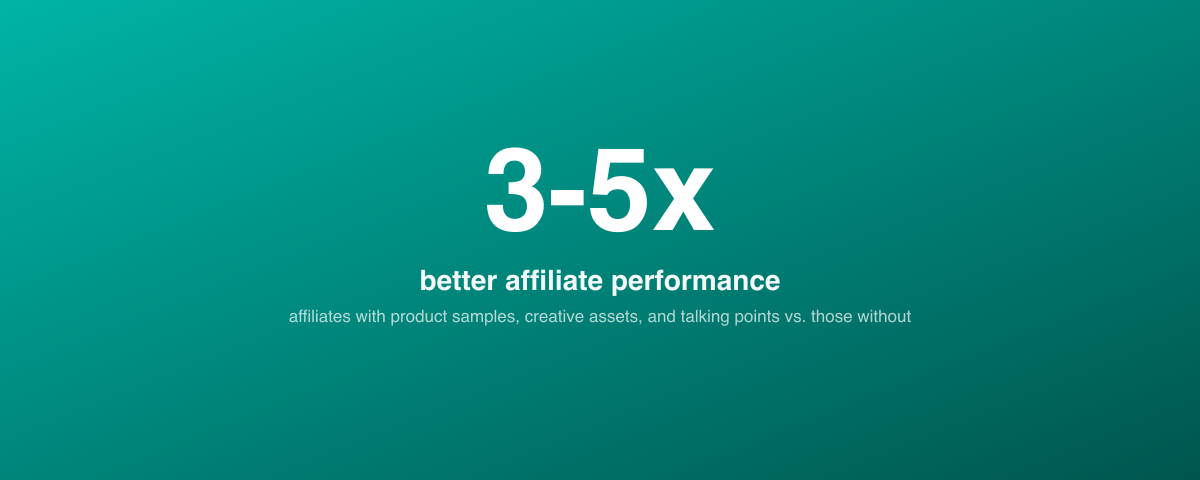
Provide affiliates with what they need to convert. The biggest driver of creator affiliate performance is creative assets and product knowledge. An affiliate who has used your product, has high-quality product images, knows the key talking points, and has a compelling offer to share will outperform one who has none of these by a factor of 3–5x. Quarterly creator packages with sample products, updated creative assets, seasonal angles, and best-performing talking points are table stakes for a serious program.
Exclusive affiliate offers. Affiliates perform better when they can offer their audience something they can't get anywhere else. An exclusive bundle, a product color only available through affiliate links, or a limited free gift with purchase performs better than a generic 10% discount code that's also available on RetailMeNot. The exclusivity makes the creator's recommendation feel like access, not just a discount.
Tiered commission structure. Reward top-performing affiliates with higher commission rates. A creator who drove 30 new customers last quarter should earn 20% commission rather than 12%. The economics are easily justified — their customer acquisition cost is below your target CPO even at higher commission rates, and the structure incentivizes higher-volume affiliates to prioritize your program over competitors.
Regular performance reviews and communication. Monthly check-ins with your top 10–20 affiliates, quarterly program performance reviews shared with your full active affiliate base, and a proactive response time (under 48 hours) for affiliate support questions. Affiliates who feel supported and informed produce more content and more recommendations.
How do you measure incrementality?
The most important measurement question in affiliate marketing is: would these customers have bought anyway?
"The most important measurement question in affiliate marketing is: would these customers have bought anyway?"
— Dhruvit Shah, Co-Founder — Performance Marketing & Growth Strategy
The attribution challenge is real — a last-touch cookie model will credit affiliates with conversions they didn't cause if those customers were already in your acquisition funnel from other channels.
The most defensible measurement approach for affiliate programs is a combination:
Post-purchase survey. The "where did you hear about us?" question in your post-purchase survey should include creator or affiliate content as an option. When affiliate-referred customers report the creator as their discovery source, that's incremental. When they don't mention the creator despite using the affiliate link, it's likely not incremental.
New-customer vs. returning-customer segmentation. Break down your affiliate-referred orders into new customers and returning customers. A program where 60%+ of affiliate-referred orders are returning customers who already knew about the brand is primarily a discount distribution network. A program where 70%+ of orders are from new customers is doing acquisition work.
Coupon code vs. link attribution. If you use discount codes alongside tracking links, compare conversion rates. A customer who uses an affiliate discount code without clicking the affiliate link first is almost certainly a coupon seeker who found the code through a coupon aggregator. These orders don't represent affiliate-driven acquisition.
Our performance marketing work includes affiliate program audits and builds for D2C brands at various stages — from initial program setup to restructuring programs that have drifted toward coupon distribution. The common finding is that the right 20 creator affiliates driving genuine new-customer acquisition outperform 200 coupon affiliates driving margin-negative revenue attribution. Quality of partnership is the variable that matters.
What does a mature program look like?
A well-built affiliate program at a $20M+ D2C brand looks like this: 15–30 active content creators and publishers generating 200–400 new customer orders per month at a CPO 20–30% below the brand's paid social CPO. 50–100 semi-active affiliates in the database contributing occasional orders. 3–5 coupon affiliates managed strictly to prevent margin cannibalization, with attribution rules that limit credit to genuinely coupon-motivated purchases. Monthly commission outflow of $8,000–$20,000 representing 8–12% of affiliate channel revenue. A program manager or agency relationship spending 5–10 hours per week on recruitment, optimization, and creator support.
Related guides
- D2C Retention Marketing: Email, SMS, and Owned Channels That Drive Repeat Revenue
- D2C Retention: How to Turn One-Time Buyers into Loyal Customers
- Influencer Marketing in 2026: Real ROI or Expensive Vanity?
- Customer Lifetime Value: The Metric That Should Drive Every Marketing Decision
That's a channel contributing $80,000–$200,000 in monthly revenue at an efficiency level that competes with, and often outperforms, paid social — with the added advantage that the content these creators produce lives on their channels indefinitely, generating search traffic and organic discovery for years after the initial commission is paid.
PART OF OUR SERVICE
Performance Marketing
PROOF FROM A CLIENT
2.7x revenue growth
from ₹27L to ₹72L monthly online revenue (approx. $32K to $86K) · Books & Retail
How Crossword Scaled Online Revenue 2.7x While Cutting CAC by 60%→Want a free marketing audit?
We'll review your tracking, ad accounts, and funnel — and show you exactly where the gaps are.
Get Your Free Audit →